A BRIEF HISTORY OF THE CIVIL SERVICE CLUB
GREAT SCOTLAND YARD, WHITEHALL
DEDICATION
This revised second edition of A Brief History of the Civil Service Club Great Scotland Yard, Whitehall and its environs is dedicated to our members and staff, both past and present, with particular thanks to those who, over the years, have given service on our General Management Committee, or otherwise gone the extra mile to make the club the friendly and inclusive place it is today; to all our guests now and in the future; and with special thanks to Mark Quinlan, who has given generously of his time and expertise to produce this important record of our first 70 years.
FOREWORD
The Civil Service Club in Great Scotland Yard is a unique organisation in a special building at the historic heart of government in Whitehall. Upon her accession to the throne in 1952, Her Late Majesty Queen Elizabeth II made the premises available to the Club to provide ‘a social facility within the reach of all’. Today the Club is thriving as never before, with more than 14,000 members and a mission true to its original founding. Enjoy the tale and come to visit us again soon.
Peter Wardle
Chair, Civil Service Club
TABLE OF CONTENTS
Dedication
Foreword
Part One: The History of the Civil Service Club
• The Origins of the Civil Service Club
• The General Management Committee
• The First Year of the Club’s Existence
• The Naming of Rooms and Lounges
• Great Scotland Yard in the 20th Century
• Unscheduled and Scheduled Events
• Covid-19
Part Two: The Story of Great Scotland Yard
• The Priory and Hospital of St Mary Rounceval
• Scotland
• The Office of the King’s Works
• The Evolution of Scotland Yard
• Great Scotland Yard Fire House
• Annex A – Civil Service Club Opening Announcment
• Annex B – The Edward Bridges Room
• Annex C – The Milner-Barry Room
• Annex D – The Elizabethan Room
• Annex E – The Trafalgar Room
• Annex F – The Churchill Room
• Annex F – The Chairs of the Civil Service Club
Part One: The History of the Civil Service Club
The Forerunner
A previous incarnation of the modern-day Civil Service Club in Great Scotland Yard was a short-lived London gentlemen’s club associated with members of the Civil Service in the mid-nineteenth century. It emerged in the context of expanding club culture in St James’s and was connected with efforts to improve the social conditions of government clerks, who were often poorly paid and overworked. The notion of such an entity appears to have arisen from the success of the Junior Carlton Club. According to Thomas Hay Sweet Escott’s Club Makers and Club Members (1914), the proposal was taken up by officials connected with St Martin’s le Grand (HQ of the GPO) and the War Office.
The movement reflected a desire among civil servants for a respectable and comfortable meeting place, where they could dine and socialise at reasonable cost. One of the principal figures associated with the club’s foundation was Sir John Milton (1820-1905), a senior War Office official. He was noted for his administrative ability and efforts in support of Florence Nightingale’s hospital reforms during the Crimean War (1853-56). He was a cousin of the novelist and civil servant Anthony Trollope, (1815-82) who had himself experienced the difficulties of junior employment in the Post Office. Trollope supported the idea of improving the social circumstances of civil servants, although Escott suggests that he was less enthusiastic than some of his Post Office contemporaries.
Escott identified Admiralty Contracts Superintendent Sir Antonio Brady (1811-81) as the club’s real founder. Other early supporters included Sir Henry Cole (1808-82), founding director of the South Kensington Museum – now known as the Victoria and Albert Museum, and Cole’s nephew, Wentworth Lindsay Cole, manager of the Royal Albert Hall. The club’s formation was reportedly opposed by senior civil servants, who viewed such an undertaking with suspicion. The club occupied premises at 85-86 St James’s Street, London, which had previously hosted the Thatched House Tavern. That was the site of the founding of the Carlton Club by Tory peers, MPs and gentlemen in 1832.
In 1861 the lessee, J Haynes, applied to the Commissioners of Woods and Forests to grant him a long lease, in order that he might pull down the existing houses and erect ‘a new Building for a Club House and for Chambers’. Erected by Messrs. George Smith and Co., to the design of James Knowles Junior, construction commenced in 1862.
From 1866 to 1869, the building was occupied by the Civil Service Club, with residential apartments on the upper floors known as the Civil Service Chambers, or Thatched House Chambers. The club’s facilities were described as good-quality dining at moderate cost, offering members a level of comfort comparable with other London clubs, while remaining accessible to men on fixed incomes. Over time, it became necessary to recruit members from outside the Civil Service, which broadened the club’s character and made its original name less appropriate. By late 1865, the former Civil Service Club had become known as the Thatched House Club, a name derived from the site’s earlier association with the Thatched House Tavern. The Thatched House Club was established in 1865 with the aim of facilitating ‘the association of gentlemen wishing to enjoy the advantages of a Club without political bias.’ The Thatched House Club continued to occupy 85-86 St James’s Street until 1949, when it moved to the Junior Carlton Club at 30 Pall Mall. The building at 85-86 St James’s Street, later used by The Union Club and The Constitutional Club, still stands today and is known as Mark Masons’ Hall, being the headquarters of The Grand Lodge of Mark Master Masons of England and Wales.
The Premises at 85-86 St James’s Street
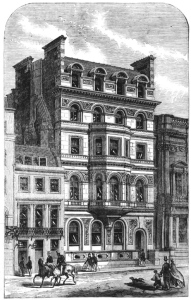
The stone façade of 85-86 St James’s Street, depicted in the 30 September 1865 edition of the Illustrated London News. The decorative carving on the exterior, representing foliage and birds was executed by sculptor John Daymond II.
The Origins of the Civil Service Club
The origins of the Civil Service Club may be found in the evolution of organised sport. On 4 November 1921 a meeting was held in the George Thomas Room at Methodist Central Hall, Westminster to consider a proposition for the formation of a Civil Service Sports Council (CSSC) to function as an umbrella body for the many sporting bodies in the Home Civil Service. More than 50 clubs and associations, including the Civil Service Athletics Association and the Civil Service Football Club were represented. The meeting was chaired by Sir Aubrey Vere Symonds, Second Permanent Secretary at the Ministry of Health, who moved the proposition, which was unanimously carried by those present.
In early 1922 the proposed body received the blessing of Sir Warren Fisher, Permanent Secretary of HM Treasury and Head of the Home Civil Service. Sir Aubrey was elected CSSC chairman and Sir Noel Curtis-Bennett, Divisional Inspector at the of Health, initially became honorary treasurer. Within a few months the Duke of York (later King George VI) agreed to become president and, in 1923, King George V consented to become patron. At this distance of time, we can certainly consider Curtis-Bennett to have been Britain’s first professional sports administrator. He would serve as CSSC vice-chairman for more than 20 years, eventually becoming its chairman in 1942.
David Goldblatt in his 2016 book The Games: A Global History of the Olympics would describe Curtis-Bennett as: ‘a man of such maniacal sporting and bureaucratic zeal that, at one point, he held official posts in over 60 sporting organisations and would die of a stroke while addressing the West Ham Boys and Amateur Boxing Club in 1950.’
Sport has traditionally played an important role in British culture and has given birth to a range of major international sports. In the earliest days of British organised sport, the civil service provided many of the top-class sportsmen and women of the period and inevitably, civil service teams and clubs would be the founders or instigators of a number of sporting bodies. Indeed, on 26 October 1863, eleven amateur football clubs met at the Freemasons’ Tavern on London’s Great Queen Street to found the Football Association.
Only one of those clubs survives to this day – the Civil Service Football Club, represented on that occasion by Mr George Twizell Wawn from West Bolden in County Durham, a clerk 3rd class at the War Office in Pall Mall and a stout defender on the pitch.
The outbreak of war on 3 September 1939 saw more than three million people evacuated from Britain’s major cities. Some 15 million ration books were delivered, thousands of temporary civil servants were engaged and a handful of new government departments prepared themselves for the challenge of organising life on the ‘Home Front’.
During that conflict the CSSC undertook the provision of sports facilities at the out-stations, to which many civil servants had been dispersed. The success of such centres led in 1943, to the CSSC revising its own rules, to permit the provision of recreational and social facilities. On 28 March 1944 at London’s National Portrait Gallery, off Trafalgar Square, the CSSC commenced its Annual General Meeting. Mr H G Poor moved a resolution which stated: ‘This Annual General Meeting of the Civil Service Sports Council Ltd instructs its Executive Council to appoint a sub-committee for the purpose of exploring the possibility of acquiring suitable premises in London to be used as a Civil Service Sports and Social Club, the cost to be met by money raised through the formation of a limited liability company inviting only civil servants to subscribe for £1 shares if necessary, such a club to be subsidised by the Civil Service Sports Council Limited’.
The Royal Nuptials
After much discussion the resolution was carried without dissent. A sub-committee would be established under Frederick Adolf Hartman’s chairmanship to explore the possibility of acquiring premises in London. Similar resolutions were passed with increasing support at successive CSSC AGMs, but at the height of the Second World War, the government was busily contending with the challenges arising from the need to harness the nation’s manpower and economic strength to one sole purpose – the defeat of the Axis Powers.
For that reason alone, every building or premises likely to be suitable as a social centre had already been requisitioned by the Ministry of Works. Added to which, the CSSC’s resources were, at that point, fully committed to meeting its liabilities in respect of the maintenance and upkeep of grounds and sports facilities at its evacuation centres.
The CSSC thus found itself without the financial means to carry its plans into effect, even if it had identified a suitable property. On the evening of 7 May 1945, the nation learned from BBC Radio that the war in Europe was over. After six long years, that news was received with profound relief and Japan surrendered on 15 August. The government commenced dismantling the machinery of war, demobilising more than four million men and restoring the nation’s fabric, although food rationing would not end until 4 July 1954.
Princess Elizabeth first encountered Prince Philip of Greece and Denmark on 29 November 1934 at the wedding of Prince George, Duke of Kent, to Princess Marina of Greece and Denmark. After a third meeting in July 1939, the future queen, who was 13 years old at the time, is said to have fallen in love with Philip and they began exchanging letters. The couple became secretly engaged in 1946 and Elizabeth’s father, King George VI, decided that any formal engagement would be delayed until after his daughter’s 21st birthday in April 1947. Their engagement was officially announced on 9 July that year.
In advance of the wedding of the Princess Elizabeth and Lieutenant Philip Mountbatten, Duke of Edinburgh, which took place at Westminster Abbey on the morning of 20 November 1947, the Home Civil Service and Foreign Service undertook a collection for the purpose of purchasing a suitable present to celebrate the royal nuptials. Two silver salvers were obtained from silversmith C J Vander of Fetter Lane, Holborn, London.
The first is a circular silver salver in King George II style, with moulded rim, on four scroll feet, the centre engraved with the coat of arms of the Duke of Edinburgh, with crest and supporters. Engraved on the reverse is the inscription: ‘A gift / on their marriage / to Her Royal Highness / The Princess Elizabeth and / Lieutenant Philip Mountbatten RN / from all ranks of / His Majesty’s Civil and / Foreign Services / 20 November 1947.’
The second is also a circular silver salver in King George II style, with moulded rim, on four scroll feet, the centre engraved with the coat of arms of the Princess Elizabeth, with coronet and supporters. Engraved on the reverse is the inscription: ‘A gift / on their marriage / to Her Royal Highness / The Princess Elizabeth and / Lieutenant Philip Mountbatten RN / from all ranks of / His Majesty’s Civil and / Foreign Services / 20 November 1947.’ The couple received more than 2,500 wedding presents from relatives and well-wishers around the world, which were displayed in an exhibition mounted at St James’s Palace, which attracted more than 200,000 visitors. The accompanying brochure described Gift 1118 as: ‘HIS MAJESTY’S CIVIL AND FOREIGN SERVICES / Pair of large silver salvers of plain design with Bath / borders and scroll feet.’ The two gifts are in the Royal Collection, being catalogued RCIN 15971 and RCIN 15972.
The Two Silver Salvers
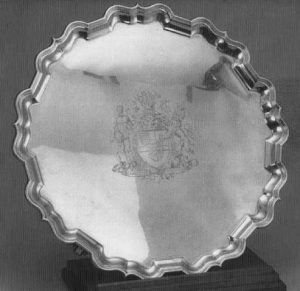
The Prince Philip Salver – Royal Collection Trust / All Rights Reserved.
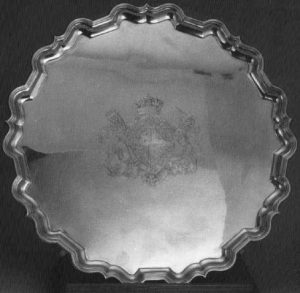
The Princess Elizabeth Salver – Royal Collection Trust / All Rights Reserved.
The Queen’s Gift
The balance of the Wedding Fund collected by His Majesty’s Civil and Foreign Services was £14,037 (equivalent to £539,525.94 in 2018). The Princess Elizabeth was touched by the kindness of the gesture and made her wish known to officials that the balance should be handed over to the CSSC, with the express intention that it be utilised to establish a social facility for civil servants: ‘on condition that membership should be available to all grades and classes at a subscription within reach of all.’ In time, that remarkable instance of royal generosity would become known as ‘The Queen’s Gift.’
As post-war Britain slowly returned to normality, the brightest minds of the senior civil service redoubled their efforts to identify a suitable premises in the Whitehall neighbourhood. They soon noticed the former fire house in Great Scotland Yard, which would become vacant in early 1953, when it would cease to function as a Festival of Britain press bureau and was due to be handed back to the Ministry of Works at 3 Whitehall Place. The Queen’s Gift enabled the CSSC to bring its plan for a civil service club to fruition, with a substantial sum in reserve, should they be minded to draw upon it.
On 6 February 1952 King George VI died in his sleep and Princess Elizabeth, who was then in Kenya, acceded to the throne as Queen Elizabeth II. Upon her return, she would write: ‘On my accession to the Throne, I desire to convey my warm thanks to all grades of the Civil Service for the able and devoted manner in which they have carried out their duties during the reign of my father. The high respect in which the Civil Service is held in the United Kingdom is the reward of centuries of faithful work for the community. Its traditions and standards are shared by the younger Civil Services of the countries of the Commonwealth. I know that the loyal and steadfast spirit of all of these services will be my enduring support throughout whatever difficulties the future may hold in store.’
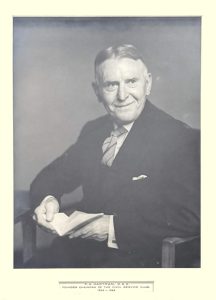
On 11 December 1952 Sir Edward Bridges, Permanent Secretary to HM Treasury and Head of the Home Civil Service, wrote to all government departments, informing them that a civil service club would soon be opening in in Great Scotland Yard and seeking support for that worthy enterprise. In his covering note, Sir Edward exhorted their permanent secretaries to do all they could personally to ensure the success of the enterprise. Sir Godfrey Ince, Chairman of the CSSC added his voice to that of Sir Edward, thus ensuring that his council members, area associations and affiliated bodies were kept apprised of developments. Unsurprisingly, given the many years he had devoted to the project, Mr Frederick Adolf Hartman was appointed the club’s chairman and Mr Charles F Stewart the club’s honorary secretary, initially on secondment from HM Treasury.
The club’s officers negotiated with officials at the Ministry of Works, to secure the property for its use. The freehold of the premises is held by the Cabinet Office on behalf of the Civil Service Club and was administered under a Memorandum of Understanding issued to the CSSC. By such means, the club was brought into being as a social facility for all civil servants, of whatever grade, both serving and retired, whether resident in London, or in the provinces. The club has been responsible for the repair and maintenance of its premises since the Memorandum of Terms of Occupation drawn up by the CSSC and signed on 5 December 1996. A lease was not issued until 2017, which secured the use of the premises until 2042. The process of the club unwinding and redefining its relationship with the CSSC would take more than 60 years and would only be completed by changes to the club’s constitution which
were enacted in 2018.
The Young Queen
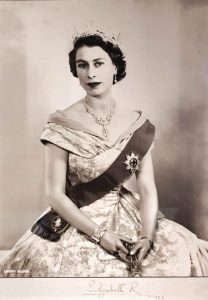
Queen Elizabeth II, photographed at the commencement of her reign.
The General Management Committee
Sir Edward Bridges initially resisted the notion that the premises should be licensed to sell alcoholic beverages. He only gave way under the pressure of popular demand and an application for a licence to sell alcohol was submitted to the Board of Green Cloth at St James’s Palace. In a throwback to Great Scotland Yard’s historic origins, the club came under the jurisdiction of that royal body, presided over by the Lord Steward. It took its name from the tablecloth of green baize which covered the table at which its members sat. It audited the accounts of the Royal Household and undertook arrangements for royal travel. It also sat as a court upon offences committed within the verge of the royal palaces.
Its jurisdiction was limited to the sale of alcohol, betting and gaming licenses for premises falling within the areas attached to, or governed by, the royal palaces. There were a number of public houses and clubs within the jurisdiction of the board, which was limited to what had been the private grounds of the sovereign and they included Carlton House Terrace, the northern end of Whitehall and the National Gallery (former site of the Royal Mews). With the reforms to local government licensing brought about by Section 195 of the 2003 Licensing Act, the Board of Green Cloth quietly disappeared into history.
Without fanfare, the club opened its doors for business on the morning of 2 February 1953. The Civil Service Sports Journal reported in their edition of March 1953: ‘It was a bit of a scramble to get everything ready for the opening, but somehow, it was done and the doors were opened on 2 February as had been announced. Contrary to expectations there was a fairly gentle flow of visitors. Everyone was thrilled with the style and furnishing of the club and the few that had any criticism did no more than express doubts about the premises being large enough. I said in my notes last month that voluntary workers had managed to cope with the rush of applications. I spoke too soon! Since that time, the increasing band of helpers has been overwhelmed by a deluge of forms. I understand that the lost ground is being made up and that those who were disturbed about the late receipt of membership cards will soon be receiving them.’
The club’s General Management Committee comprised twelve members and was originally a sub-committee of the CSSC, until the year following, when the membership elected their own officers for a one-year term at the Annual General Meeting. The officers of the club comprised a chairman, vice-chairman, honorary secretary and treasurer, who were all initially appointed by the CSSC from among the club’s membership.
It would not be until the AGM held on the club premises on 19 September 2023, that the constitutional anomaly whereby the honorary officers were elected for a one-year term and members of the General Management Committee for three years was resolved by a motion equalising the terms for both at three years. That motion was sponsored and tabled by the club’s officers being endorsed by the members present.
The inaugural meeting of the club’s General Management Committee took place on the evening of 24 February 1953. On the very first agenda was the disdain of the two hall porters for the second-hand uniforms they had been allocated and detailed planning for the celebrations of the impending coronation of Queen Elizabeth II at Westminster Abbey on 2 June 1953. In time-honoured civil service fashion, much of the administration of the club would be delegated to sub-committees established for specific purposes. Indeed, such was the enthusiasm for establishing and serving on them, one was even convened to supervise and oversee the decoration of the Tea Bar on the ground floor.
The First Year of the Club’s Existence
In the first year of the club’s existence, the minutes of the General Management Committee disclose that they considered such knotty issues as: staff wages, cloakroom insurance, tipping in the restaurant, lift problems, dilapidations, beer temperature, members smoking at the tea counter, the proposed establishment of a barbers’ shop, the consternation caused by the constant disappearance of magazines from the lounges, the size and cost of pats of butter, soft furnishing issues, stocktakes and the saga of the missing teaspoons, which would go on for decades. By far and away the greatest burden fell on the catering sub-committee, which spent much time grappling with prices, mechanical ovens, portion control, the drawing up of menus, the procurement of catering equipment, staff shortages and the never-ending quest for a suitable catering manager.
In the early years a number of hall porters were discharged, having been found unfit for duty through drink, usually having been purchased by well-meaning members. The management ordinarily made discreet enquiries into the background of potential hall porters, but learned that the more upright the candidate was, the more likely it was that he would be corrupted by the members, who would insist on demonstrating their generosity. The club would eventually realise that worldly men were less likely to succumb to temptation and in time recognised that ex-servicemen tended to be the steadiest types.
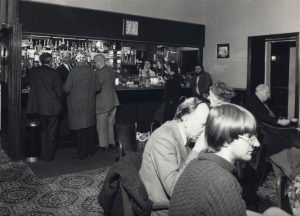
Civil servants taking a break from their labours in the club’s bar in the 1970s.
The 1954 Royal Visit
The civil servants who comprised the original General Management Committee kept a close eye on the day-to-day running of the club, asked searching questions on the right issues, were fortunate in their selection of key personnel and quickly acquired a degree of commercial awareness. Consequently, the club soon achieved a healthy trading surplus. The minutes of the Management Committee meeting held at the club on the evening of 11 May 1953 detail the feverish planning underway in preparation for the Queen’s coronation at Westminster Abbey and an application for a late licence was duly submitted to the Board of Green Cloth. The coronation date was chosen specifically on the advice of experts at the Meteorological Office, who predicted that it was statistically likely to have the best weather. Unfortunately, the great day would be overcast, with sporadic outbreaks of rain and a chill wind. General Manager Mr Bendall reported to the Management Committee: ‘enquiries had been received from the staff as to additional remuneration for Coronation Day. He reported that he had informed them that, in addition to the appropriate pay for the day, some extra allowance or bonus would be made: This would depend upon the services performed and the zeal of those concerned.’
In the early years the highlight of the club’s year was the Annual Dinner and Dance, usually held in London’s West End. In those heady days attendance was limited to 600 guests and tickets were available at the price of two guineas each. At the first such event, held at the Dorchester on Park Lane on 2 February 1954, Chancellor of the Exchequer ‘Rab’ Butler was guest of honour. His address lauded the club’s achievements, stating: ‘A civil servant does not regard himself as belonging to some self-contained section that works in Whitehall, or in a country town, or overseas. He belongs to the general body and makes his own particular contribution to its work.’ Mr Butler’s speech concluded with the line: ‘This is a very happy enterprise. I hope that it will go on from strength to strength.’
Sir Edward Bridges wrote to Lieutenant Colonel Sir Michael Adeane, the Queen’s Private Secretary, to arrange a visit by the Queen, for the purpose of a formal opening of the establishment. Sir Michael responded that Her Majesty wanted to see the club functioning, just as it would on any ordinary day and that she would be pleased to partake of a glass of sherry immediately prior to her departure. On 23 August 1954 The Northern Whig and Belfast Post reported: ‘The Queen is to visit Britain’s fastest growing club after her holiday at Balmoral. It is the Civil Service Club, 13-15 Great Scotland Yard, which, founded over a year ago, already has 38,000 members. In visiting the club the Queen is not just making a formal gesture for she takes great interest in its development and in a way it is her own club. It has been equipped with the money collected from the Civil Service for the Queen’s wedding present. She said she would accept some suitably inscribed pieces of silver and asked that the rest of the money be devoted to furnishing the club. Although it took five years to get it completed it has been an immediate success.’
The royal visit took place at Remembrancetide on 10 November 1954. Lieutenant Colonel Martin Charteris, Her Majesty’s Assistant Private Secretary, wrote to inform the officers of the club: ‘How greatly the Queen had enjoyed her visit and how impressed she was with all that she saw. Her Majesty was delighted to see that the Wedding Fund had been put to such good purpose and commanded Colonel Charteris to thank the committee very much for the refreshment given her at the end of the visit.’ At the same time, Her Majesty graciously consented to become patron of the Civil Service Club.
Her Majesty The Queen and the Officers of the Civil Service Club
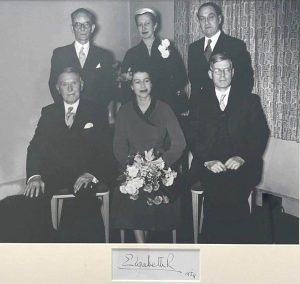
W T Yates (Hon Treasurer) Miss Rosalind Culhane MVO, OBE (Vice Chairman) Charles F Stewart (Hon Secretary)
Frederick Adolf Hartman (Chairman) Queen Elizabeth II The Rt Hon Sir Edward Bridges GCB, GCVO, MC (Permanent Secretary to the Treasury and Head of the Home Civil Service)
The Club’s Membership
The election of proposed members took place in committee, with batches of names being presented for approval, these being proposed and seconded by officers nominated for the purpose. Each successful applicant would, in due course, be sent a membership card in a black cover, which bore the title ‘Civil Service Club’ in gilt lettering. However, the rate at which civil servants initially applied for membership caused an administrative headache for the club’s staff, with applications arriving much faster than they could be processed.
That development caught the General Management Committee wholly unprepared and the honorary officers were haunted for years by the question of what would happen if all these members turned up on the club’s premises at the same time. For that reason, the committee called a halt to all enrolments when the membership figure arrived at 27,000. Following that decision, all subsequent applications were placed on a waiting list.
After monitoring the situation for some months, the committee decided to lift the embargo in the hope that bringing the top three floors of the premises into service would help to cope with additional usage arising from increased membership. The matter was then kept under regular review. The club’s earliest membership records disclose that, at the outset, the elected membership of the club was 17,895 members, which quickly rose to 24,825 by the end of March 1953. By June of that year there were 29,657 members.
On 31 December 1953 there were 31,972 members. These being 130 Associate Members, 13,061 Country Members and 18,601 Town Members, who paid a subscription of a penny a week, deducted from salary by their employing department.
In the early days the General Management Committee spent much time pondering the original intention behind the club’s Rule Four, which determined which civil servants and of which departments, could become members. They assessed the eligibility for membership of the staff of organisations such as Trinity House, the British Electricity Authority and the Medical Research Council. Those New Scotland Yard civil servants who had been erroneously admitted to the club’s membership were speedily refunded.
One particular organisation which fell foul of Rule Four was the Crown Agents’ Office, whose staff were servants of the Crown, but not part of the Home Civil Service. Despite some fairly heavy artillery being wheeled onto the battlefield, the General Management Committee resolutely refused to budge from their position that these staff were not civil servants and thus ineligible for membership. That situation was further complicated by the fact that the CSSC constantly revised its own criteria as to what constituted a ‘fringe body’. By the mid-1960s the club was shedding 500 members a year, which ensured that this potential source of new members remained a permanent fixture on the General Management Committee’s agenda. Unsurprisingly, motions attempting to amend Rule Four would dominate the club’s early annual general meetings. These proposed to broaden the interpretation of the rule, to include staff of the Church Commission for England, the Crown Agents, the Overseas Audit Service, the Imperial War Graves Commission (since 1960, the Commonwealth War Graves Commission) and others. The staff of those organisations would in time, all become eligible for membership.
In the early years, AGMs were well-attended, usually being held on the premises of a nearby government department, as the club was not large enough to hold all who wished to attend. The proceedings were enlivened by unscripted contributions from the floor, which were dreaded by the club’s honorary officers, but kept them all on their toes.
The Membership Application Form
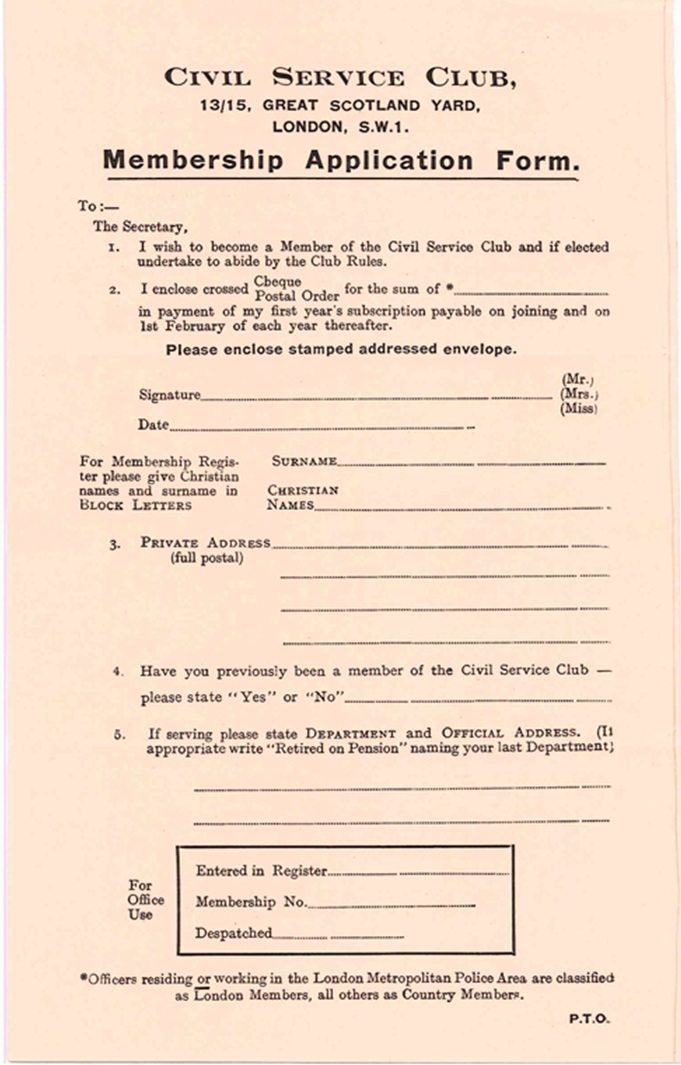
The Early Years
The architect Hilton Wright was engaged to bring the fourth and fifth floors of the premises into commission as overnight accommodation for members and the necessary building work was quickly set in hand. Mr Wright was no stranger to 13-15 Great Scotland Yard, having previously been responsible for converting the premises into a press bureau, in readiness for the Festival of Britain. His endeavours would be rewarded by the General Management Committee with life membership of the club, the very first grant of its kind.
The first outing to the Derby at Epsom Downs Racecourse in Surrey took place in the club’s very first year of business, with tickets going on sale to members at a price of 32 shillings and sixpence. That bibulous, coach-borne jamboree for equine enthusiasts has been a permanent fixture on the club’s social calendar each June ever since.
The concrete reinforced air raid shelters, which had been installed under the building during the late war, quickly proved unsuitable for keeping wine, a problem soon resolved by Mr Hurst, the consulting architect, who quickly arranged for the installation of ventilation in order to maintain a constant temperature in the cellar. In 1959, through the agency of the Ministry of Works, the building was connected to the ‘Whitehall District Heating Scheme’, otherwise known as ‘The Grid’, which supplied heating from furnaces in the basement of the nearby Whitehall Gardens Building, which housed the Air Ministry and the Board of Trade (today, the Ministry of Defence). The Grid would produce its own unique challenges in the decades following. For that reason, the premises was maintained by the Ministry of Works and, following its demise in 1970, by the Property Services Agency and then, its successor, Building Management South East (Estates).
In due course, complaints from members would be lodged with the General Management Committee, each one having to be investigated. Conversely, disciplinary issues would also arise from the conduct of the membership, with individuals being held to account for the non-removal of headgear by gentlemen in the bar, overloud football commentary on TV, instances of poor behaviour and cheques being returned by the bank marked ‘refer to drawer.’ It says much about how British society’s attitude to disability has transformed since 1960 that a club member (who worked for the Board of Trade) had to write to the Management Committee to request permission for her guide dog to access the premises. The committee agreed (a) to the admission of the guide dog in question, on the understanding that it would be kept under control, and (b) to a continuance of the discretion vested in the club secretary or manager in any future similar case.
On 11 February 1966 the club held its Annual Dinner and Dance at the Europa Hotel on Mayfair’s Park Lane. Club President Sir Laurence Helsby received the guests. The guest of honour on that occasion was Douglas Houghton, MP, Chancellor of the Duchy of Lancaster. Over a span of 38 years, from 1922 to 1960, Houghton was General Secretary of the Inland Revenue Staff Federation. Under his leadership that trade union attracted a 95 per cent voluntary membership, without the benefit of a ‘closed shop’, despite the fact that its 10,000 members were scattered across some 600 towns and offices, the length and breadth of the UK. The top table that night included: Sir Charles Cunningham, KCB, KBE, CVO (Home Office); Sir John Winnifrith, KCB (Ministry of Agriculture, Fisheries and Food); Sir Henry Hardman, KCB (Ministry of Defence); Sir Harvey Druitt, KCB (Chairman of the Civil Service Sports Council) and Mr Richard Hayward (Secretary General, Civil Service National Whitley Council (Staff Side)).
The Epsom Derby
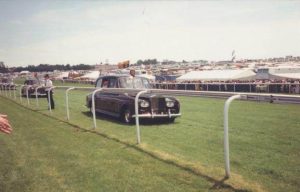
Someone rather important arriving on the racecourse.
club member assessing the generosity of the on-course bookies.
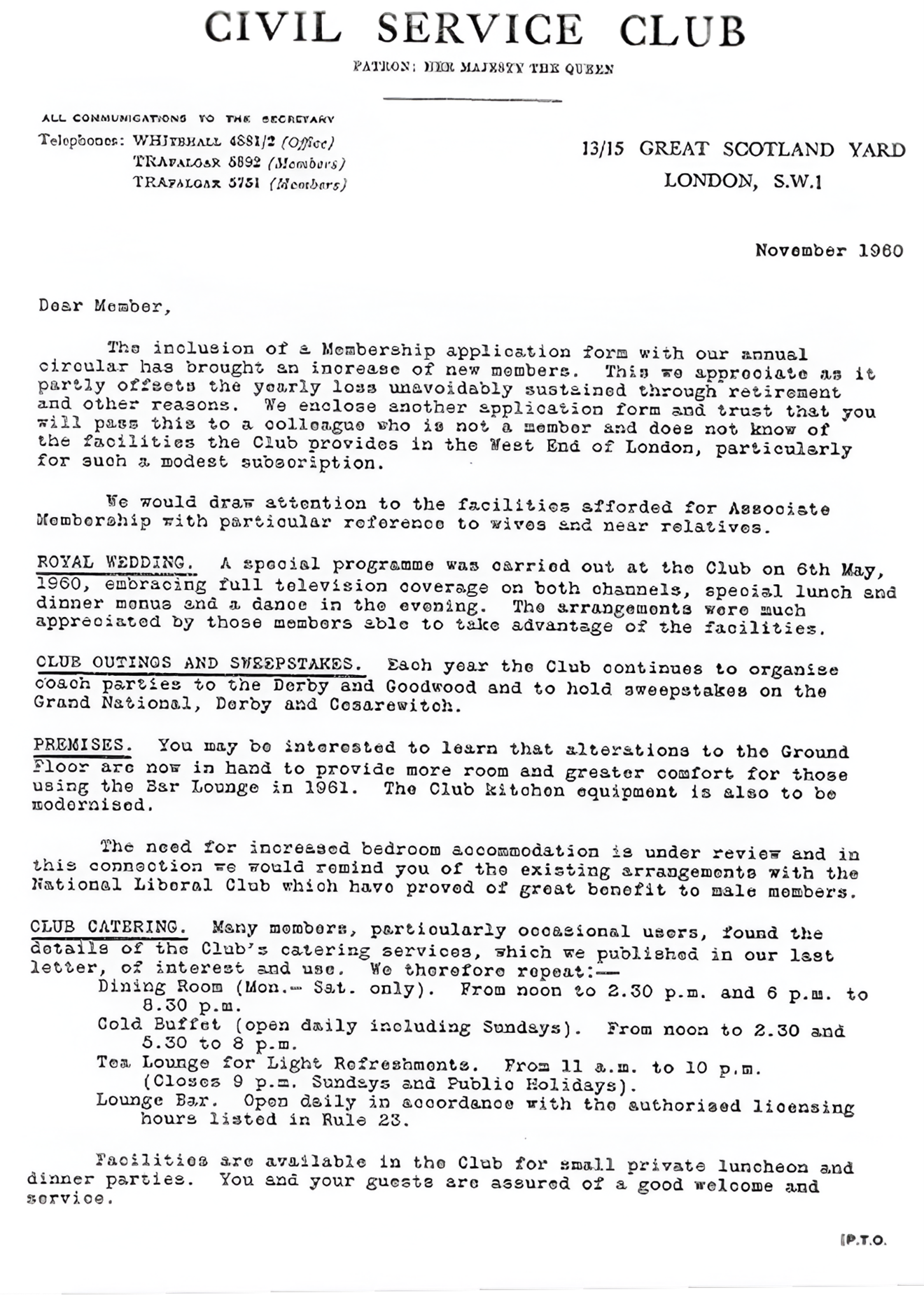
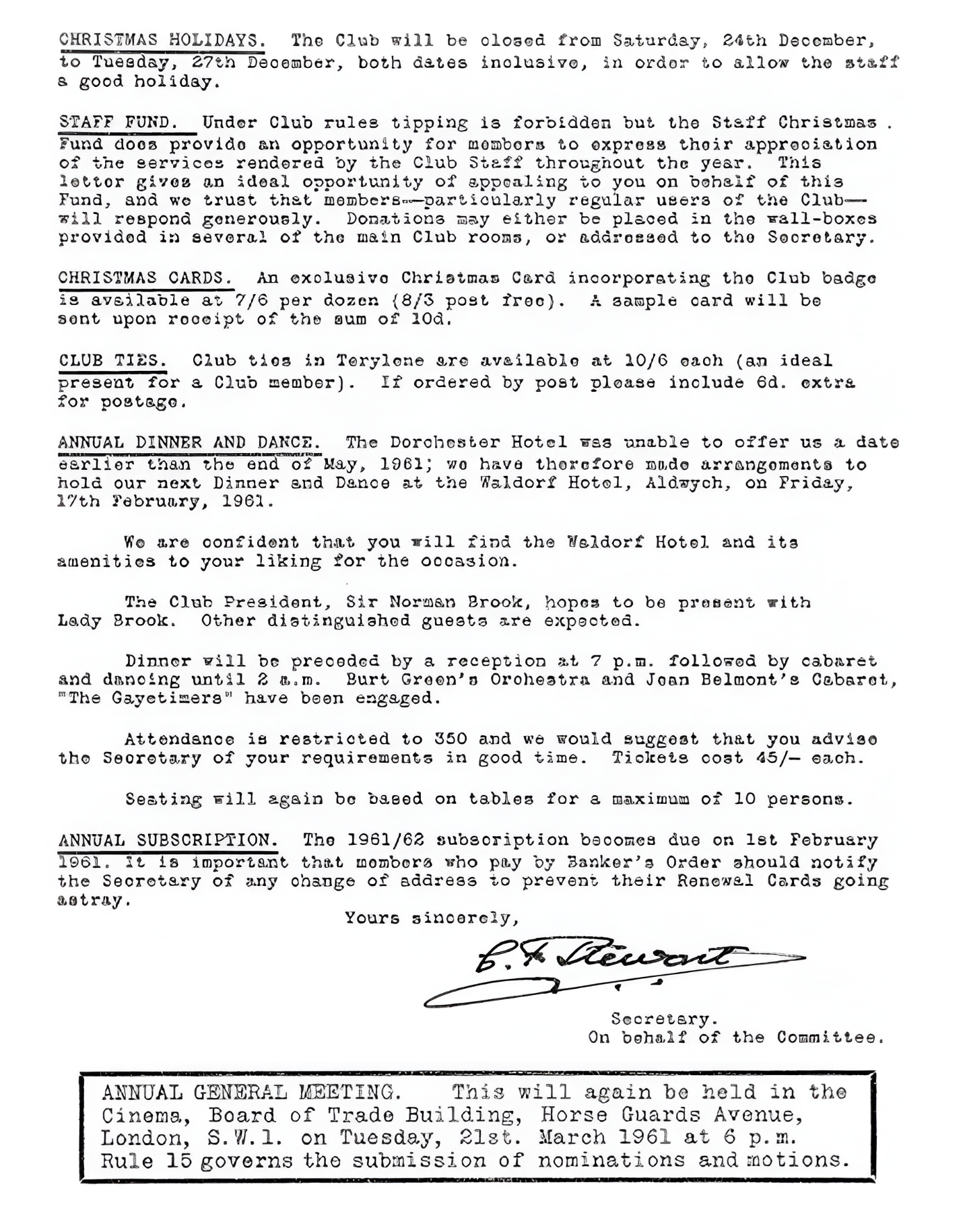
The Club Newsletter, November 1960
The Naming of Rooms and Lounges
The 1 November 1966 minutes of the General Management Committee record: ‘The secretary said that, following on the authorisation given at the last Committee Meeting, he had again interviewed Mr Harkins with the result that, on 10 October 1966, he had taken up the appointment of catering manager at a salary of £1,000 a year. It had been made quite clear to Mr Harkins that any increases in salary would depend entirely on his showing a marked improvement in the returns from catering. These were early days, but Mr Harkins was showing every sign as being the man for whom we have been seeking.’
Unfortunately, the inability of the restaurant kitchen to serve a meal to anyone on the evening of 10 January 1967, due to the non-availability of the chef, heralded a parting of the ways for Mr Harkins. Such was the difficulty in recruiting and retaining kitchen staff, at one point in 1967, a rota of committee members was cooking breakfasts for members.
It would not be until the close of 1967 that the linoleum of the restaurant was carpeted, at a cost of £732 and 12 shillings, thus transforming its appearance from a works canteen into something rather more welcoming. With the passage of time, various meeting rooms and lounges would be named after figures in the history of the club, or significant events in British history. A description of each may be found in the annexes to this document. Edward Bridges was the son of Poet Laureate Robert Bridges, author of the poetry collection The Testament of Beauty. In the Great War, Bridges served with the Oxfordshire and Buckinghamshire Light Infantry on the Western Front, becoming adjutant of their 4th battalion, He was seriously wounded, invalided out of the service and entered the civil service. In 1938 he succeeded Colonel Sir Maurice Hankey as Cabinet Secretary.
In 1946 Bridges was appointed Permanent Secretary to HM Treasury and Head of the Home Civil Service, a position he would retain until 1956. He was the most eminent civil servant of his generation, in an age when the service was not short of talent. In 1957 he was raised to the peerage as Baron Bridges of Headley, in the County of Surrey, and of St Nicholas at Wade, in the County of Kent. He was invested a Knight of the Garter in 1965 and died in 1969. Historian Peter Hennessy in his 1989 book Whitehall would describe Bridges as: ‘the finest flowering of the Victorian public servant – high minded, politically neutral, a gifted all-rounder who believed that government was best served by crowding the higher Civil Service with latter-day Renaissance men.’ The club’s Edward Bridges Room is named in his honour. More about his life may be found at Annex B.
Stuart Milner-Barry was educated at Cheltenham College and was an outstanding chess player, winning the first British Boys’ Championship in 1923. He won a scholarship to Trinity College, Cambridge, taking First Class honours in Classics (Part I) and Moral Sciences (Part II). At the outbreak of the Second World War, he was recruited to the top-secret Government Code and Cypher School at Bletchley Park, where he eventually ran Hut 6. Its task was to crack the Enigma codes used by the Wehrmacht and Luftwaffe.
After the war Milner-Barry joined HM Treasury as a principal. Apart from a stint in the Ministry of Health in the period 1958-60, he remained with the Treasury until 1966 when, aged 60, he reached retirement age. He stayed on to run the honours system. He was appointed OBE in 1946 for his work at Bletchley Park, CB in 1962 for his labours at HM Treasury and KCVO in 1975. Sir Stuart was one of the earliest trustees of the Civil Service Club. He retired in 1977 and died in March 1995. The Milner-Barry Room is named in his honour. More on his remarkable life and career may be found at Annex C.
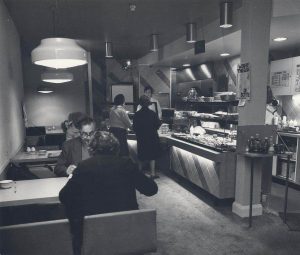
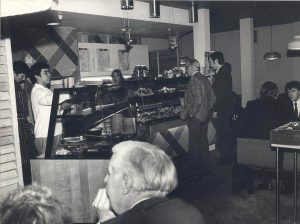
The Tea Bar on the Ground Floor in the 1960s
Of Mice and Men
The early volumes of the club’s minute books explore in some detail, the comings and goings of staff. Any number of second chefs came and went. Reliable waitresses and chambermaids could not be had for love nor money. Casual staff were heavily relied upon, with the services of Westminster Labour Exchange being in constant demand. The departure of two Chinese chefs is also explored. Upon the catering manager attempting to allocate them to different shifts, it became apparent that one of them spoke no English at all, a shortcoming that could well have been identified at the time of his recruitment.
However, the club had one weapon in its armoury which it deployed effectively. From the outset it operated a Christmas bonus scheme and the sums involved were most generous by the standards of the day. The longer a member of staff served, the greater the bonus. This had a considerable effect on staff retention in a highly competitive labour market. Another factor in play was no doubt the solicitude of the Management Committee when it came to all matters relating to staff. Much attention was paid to provision for staff who were ill, those who had fallen on hard times, or those who had given lengthy service.
Throughout 1968 bulletins on the waning health of Mrs ‘Dolly’ Piper, a long-serving member of staff, would regularly feature in the minutes of the Management Committee. The minutes of 7 January 1969 disclose: ‘The secretary reported that since the last Management Committee meeting, news had been received that Mrs Piper had suffered another heart attack and this time it had been fatal. As her husband was still in hospital, that news had been kept from him. However, on Christmas Eve, he too expired.
In October 1966 the issue of club staff drinking whilst on duty was finally resolved, with the placing of a notice on the board in the staff rest room, that the practice was now prohibited. At the same time, the bar staff were instructed that they were not to serve any member of staff alcohol whilst they were on duty. At that point in proceedings there was not the clear distinction of roles between the management and committee members that obtains today and, consequently, some of the brighter members of staff played off the committee members against the management team by saying that the pint of beer they were drinking had been purchased for them by such-and-such a committee member.
In February 1968 Sir William Armstrong succeeded Sir Laurence Helsby as the club’s president. Sir Laurence was created a life peer on 21 May 1968, with the title Baron Helsby of Logmore, in the County of Surrey. Both Armstrong and Helsby had served together as joint permanent secretaries of HM Treasury in the period 1963-68.
One of the hazards of occupying a building next-door to a working Metropolitan Police stables is the presence of mice. On 19 November 1968 mouse droppings were discovered in the downstairs kitchen of the club and the club secretary was informed. He quickly came to the conclusion that the place was overrun by mice. On telephoning the Ministry of Works he added insistence to the matter by advising them that, unless urgent action were taken, the club would soon be moving down Whitehall, carried on the backs of mice. That same afternoon an inspection was carried out by a hygiene officer from the Ministry of Works and a rodent control officer. It soon became apparent that a large-scale infestation had taken place, as all the dressers and cupboards in the kitchen bore signs of the presence of mice. In one cupboard there was a three-and-a-half-pound tin of chocolate sauce. Embedded in its centre was a deceased rodent. The adoption of new hygiene procedures by catering staff and the laying of bait quickly resolved the problem.
Great Scotland Yard in the 20th Century
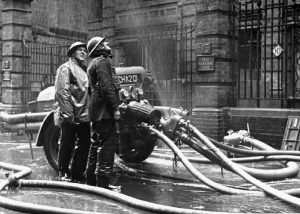
The Blitz comes to Great Scotland Yard during the Second World War.
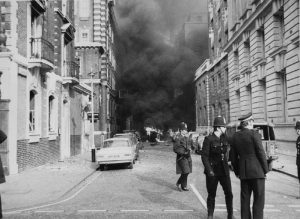
IRA bomb detonates in Great Scotland Yard on the afternoon of 8 March 1973.
Unscheduled and Scheduled Events
In the early 1970s the Irish Republican Army (IRA) carried out a series of bombings, assassinations and ambushes in a campaign they called the ‘Long War.’ In 1973 their Army Council drew up plans to expand their operations and bring terror to mainland Great Britain. On the afternoon of 8 March 1973, they detonated a car bomb in the street outside the club, having first telephoned a warning to the Metropolitan Police. Their target was the Army’s Central London Recruiting Depot, then at 1-5 Great Scotland Yard.
That device’s detonation caused chaos for the club, resulting in broken window frames, fallen ceilings and shattered glass everywhere. Fortunately, as both staff and members had been evacuated from the premises in a timely manner, there were no casualties. Sir William Armstrong, Permanent Secretary of the Civil Service Department and Head of the Home Civil Service, visited the club later that evening and paid tribute to the efforts of all involved in restoring the premises. On the day of the bombing, Dolours Price and her sister Marian were arrested at Heathrow Airport, along with Gerry Kelly, Hugh Feeney and six others, as they were boarding flights to Belfast and Dublin.
They were part of an eleven-strong IRA ‘active service unit’, which had planted devices at the Old Bailey, Great Scotland Yard and the BBC’s Armed Forces Radio Studio in Dean Stanley Street. It would subsequently be claimed that the gang’s activities had been reported to the authorities by an informer. They were tried in the Great Hall of Winchester Castle and convicted on 14 November 1973. The sisters each served 20 years in prison. A heightened security state would be an enduringly tiresome feature of life for everyone working in Whitehall and its environs throughout the 1970s, 80s and 90s.
On 3 February 1979 the club celebrated its Silver Jubilee, with a programme of events presided over by Chairman Maurice Mendoza. On 1 February 1983 Ordinary Members (London) were paying a subscription of £10.00 per annum, with Country Members paying £5.00. Throughout the 1980s the club underwent a programme of redecoration and re-invention. The OK Bar would become The Buttery and subsequently The Wine Bar. Over the following years, the main bar would be moved from the ground floor to take up residence in the first-floor restaurant on no fewer than three occasions, to enable refurbishment to take place downstairs, with varying degrees of success. Throughout the 1990s and the ‘noughties’ the club’s management expanded the activities available to members, with discos, poker, karaoke, barbeques, magic nights, comedy nights, quiz nights, wine tasting, guided tours and bridge all making their
appearance.
On the evening of 4 February 1993, the club hosted Prime Minister John Major as principal guest at its Annual Dinner in the company of Club President Sir Robin ButlerRobin Butler, Baron Butler of Brockwell – Wikipedia and Sir Brian Unwin, Chairman of the CSSC. In May 2011 the CSSC closed its Recreation Centre at 1 Chadwick Street, at the Horseferry Road end of the parish and the Civil Service Club happily extended a welcome to the then membership, at advantageous terms for a period of time. In 2013 the club celebrated its Diamond Anniversary, with a programme of events presided over by long-serving Chairman John Whittaker. He passed away in 2017, within months of his Cabinet Office colleague and predecessor as club chairman and then incumbent Honorary Treasurer John Barker. Their devoted service is commemorated by a brushed steel plaque affixed to the wall of the Queen Elizabeth Dining Room, which reads: ‘In warm appreciation and fond memory of John Barker CB and John Whittaker CBE / Honorary Officers of the Civil Service Club 2004-2017.’
Civil Service Club 40th Anniversary Dinner, 4 February 1993
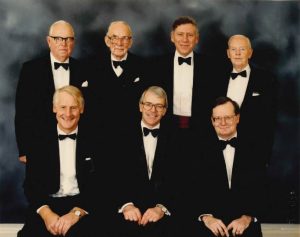
William Pullinger (Vice President) Sir Stuart Milner-Barry KCVO, CB, OBE (Trustee)
Sir Brian Unwin KCB (Chairman CSSC) Norman Seymour ISO (Vice Chairman)
Sir Robin Butler GCB, CVO (President)
The Prime Minister, The Rt Hon John Major PC, MP, Barry Miller (Chairman)
Marketing the Club in the 1990s
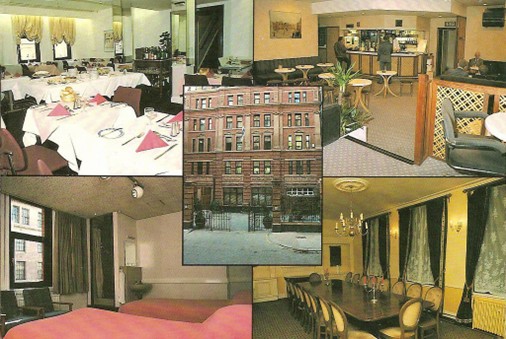
A Civil Service Club postcard dating from the early 1990s.
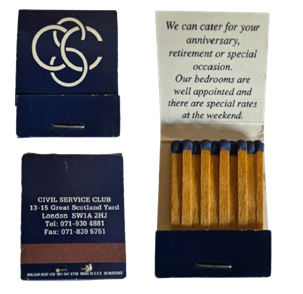
In July 2007, Prime Minister Tony Blair’s Labour government implemented a complete ban on smoking in all enclosed public places in England, including pubs, clubs, restaurants and workplaces. As well as a cigarette vending machine, the club had match books, which were available free to any smoker and was a form of advertising. From its 071 dialling code, the book above can be dated to between May 1990 and April 1995.
Covid-19
On 11 March 2020 the World Health Organisation declared the outbreak of a novel coronavirus a global pandemic. England was placed in national lockdown between late March and June 2020. Initially all ‘non-essential’ high street businesses were closed and people were ordered to stay at home, permitted to leave for essential purposes only, such as buying food, or for medical reasons. Due to the first national lockdown, the club closed between 26 March 2020 and 3 July 2020, and then reopened with social distancing regulations in place. The club again closed between 5 November 2020 and 2 December 2020, when a second national lockdown was imposed. That was quickly followed by Westminster, the City of London and all London boroughs being placed into a Tier 3 restriction region on 16 December 2020 and the club had to close its doors once more.
During the period of closure, a third national lockdown commenced on 3 February 2021, and restrictions were not eased until 12 April 2021, when the Club opened for outside trading only of food and drink, followed by inside opening on 17 May 2021. A number of rules related to table service only were eased on 27 January 2022. On 8 March 2021, England implemented a phased four-step plan to come out of lockdown, broken up by five-week intervals and all restrictions were finally lifted in England on 19 July 2021.
Throughout that period, most government departments operated a ‘work from home’ policy, which meant many staff no longer needed to travel into central London and that period was certainly the most challenging in the club’s history. However, the club’s officers, as part of their risk management strategy had foreseen the potential temporary closure of the club’s premises for several reasons, including a pandemic and had built up reserves to manage such a situation materialising. The extended period of closures and follow-up restrictions was something that had not been predicted and a tight rein was kept on finances, to ensure the survivability of the club. Being an unincorporated association conducting mutual trading, the club could not benefit from the grants available from government to the wider hospitality industry, but effective fiscal management ensured that it did not have to ask its membership for donations to safeguard its future.
During the restrictions, membership numbers dropped to 11,000 by September 2021, but throughout, the club’s management kept their eye on the future, refitting the bar kitchen, refurbishing the bar area and courtyards. In April 2021 the club introduced a digital membership card through a members’ mobile phone application, or ‘App’. It enabled the club to offer a paperless reward scheme at the point of sale and for the first time, allowed management to collect accurate data on sales and plan accordingly.
In November 2021, the club’s General Management Committee convened a working group to examine the number of public sector bodies whose staff were eligible for membership. It reviewed the potential extension of membership outside of what was in the club’s rules and decided that before potentially revising the existing rules, that there were some areas of the civil service where awareness of the club was non-existent and resolved that efforts should be made to provide awareness across the civil service first.
Contact was established with communications teams within government departments, the editors of professional journals and periodicals, and those charities and organisations which provide welfare and services to both serving and retired members of the civil service, to deliver awareness of club and its facilities. Those efforts would be rewarded by the membership steadily growing to more than 14,000 by September 2023.
The End of an Era
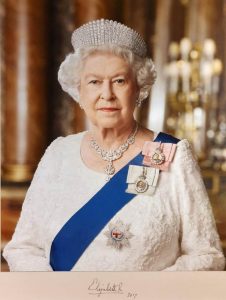
On 8 September 2022, Queen Elizabeth II, Britain’s longest reigning monarch passed away at Balmoral Castle in the Highlands. She was the last of the world’s leaders to have served in the Second World War. Her reign lasted 70 years and encompassed post-war austerity, the transition from Empire to Commonwealth, the end of the Cold War and the UK’s entry into – and withdrawal from the European Union. Fifteen British prime ministers served under her. Given that Her Majesty had been instrumental in the club’s founding, the news of her passing was keenly felt by both members and staff. A letter of condolence was despatched to Buckingham Palace. Following King Charles III ’s accession to the throne, the Royal Household announced a comprehensive review of royal patronage.
The 2023 Royal Visit
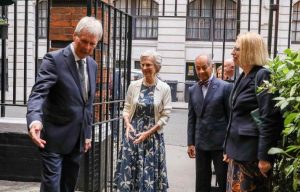
Her Royal Highness the Duchess of Gloucester is greeted by Sir Kenneth Olisa, Lord-Lieutenant of Greater London, Sir Peter Housden (left) and Dame Elizabeth Gardiner.

HRH meets representatives of the membership and members of the modern Civil Service.
The Club’s 70th Anniversary
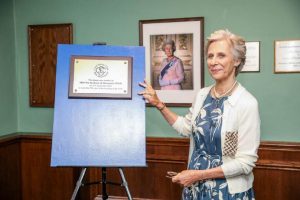
Her Royal Highness unveiling the plaque to commemorate the club’s 70th anniversary.
On the morning of 15 September 2023, Her Royal Highness the Duchess of Gloucester made a Royal Visit to the Civil Service Club, as part of the celebrations and events to mark its 70th anniversary. The reception party comprised the philanthropist Sir Kenneth Olisa, Lord-Lieutenant of Greater London, Club Chair Sir Peter Housden (former Permanent Secretary to the Scottish Government) and Dame Elizabeth Gardiner, First Parliamentary Counsel and Permanent Secretary of the Government in Parliament Group. In attendance were officers of the club; members of the General Management Committee; club members; members of club staff; representatives of the Civil Service; and representatives of the club’s partner charities and organisations, including the Charity for Civil Servants; the Civil Service Retirement Fellowship; the Civil Service Sports Council; the Civil Service Insurance Society; and the Civil Service Motoring Association.
Sir Peter gave a speech of welcome, mentioning how grateful the club was for continued royal support, to which, the duchess made a gracious reply, emphasising just how important the enduring contribution of the civil service was to the effective functioning of government and the nation. All attendees at the event wore a prominent name badge, thus giving the duchess the opportunity to speak personally to each guest.
At the end of the visit, with the assistance of Sir Peter, a commemorative brass plaque was unveiled by the duchess, celebrating the club’s 70th anniversary. It would later be mounted on the wall of the Queen Elizabeth Dining Room.
King Charles III
On 14 November 1948 Prince Charles Philip Arthur George Mountbatten-Windsor was born at Buckingham Palace. His mother was Princess Elizabeth, Duchess of Edinburgh and his father was Prince Philip, Duke of Edinburgh. He was the
eldest child of their union.
Charles was three years old when King George VI died at Sandringham on 6 February 1952 and his mother ascended the throne as Queen Elizabeth II, thus making him heir apparent. In a break with tradition, his parents decided that rather than being tutored at home, the young prince should attend school. He started at Hill House School in Knightsbridge in 1956, then attended Cheam Preparatory School in Hampshire and Godonstoun School at Elgin in Scotland, which his father had attended. He later spent six months at the Timbertop campus of Geelong Grammar School at Victoria in Australia.
Charles was created Prince of Wales and Earl of Chester on 26 July 1958. He took his seat in the House of Lords in 1970 and delivered his maiden speech in June 1974. In 1967, he entered Trinity College, Cambridge, where he studied archaeology, anthropology and history. He was awarded a bachelor’s degree there in 1971, the first ever earned by an heir to the British crown. He spent a term at the University College of Wales, Aberystwyth, learning Welsh, in preparation for his investiture as Prince of Wales on 1 July 1969, at Caernarvon Castle. He attended the Royal Air Force College at Cranwell and then the Royal Naval College, Dartmouth. From 1971 to 1976, he served with the Royal Navy, eventually commanding the Ton-class minesweeper HMS BRONINGTON. In 1976, Prince Charles founded the youth charity The Prince’s Trust.
As prince, Charles was patron, president or a member of more than 400 charities and organisations. In the past, he has criticised modernist architecture and championed the conservation of historic buildings. In 1988 he appointed Luxembourgish architect Léon Krier to prepare a master plan for an urban village, which would eventually become the experimental new town of Poundbury, on the outskirts of Dorchester in Dorset.
On 29 July 1981 Prince Charles married Lady Diana Spencer at St Paul’s Cathedral in London, in a ceremony witnessed by 750 million TV viewers across the globe. That day was declared a national holiday in Great Britain. The couple had two sons, William and Harry. In 1996, they divorced and in 2005, Prince Charles married Camilla Parker Bowles in a civil ceremony at Windsor Guildhall. In 1992 he founded the Prince of Wales’s Institute of Architecture, which later evolved into the BRE Trust, an organisation devoted to urban regeneration and development projects. In 2005 the Prince’s Foundation School of Traditional Arts at Shoreditch in London was established, with the aim to continue the living traditions of the world’s sacred and traditional art forms. It teaches students at postgraduate degree level and offers courses to the local community. On 23 May 2006 Prince Charles made a speech at the 59th World Health Assembly in Geneva, calling for the integration of conventional and alternative medicine.
On 16 June 2012 the Queen appointed Prince Charles to the highest honorary rank in all three branches of the British Armed Forces, acknowledging his support of her role as Commander-in-Chief. He became Admiral of the Fleet, Field Marshal of the British Army and Marshal of the Royal Air Force. Upon the death of his mother at Balmoral on 8 September 2022, he succeeded to the British throne and 14 other Commonwealth realms, taking the regnal name King Charles III. He was the longest-serving heir apparent in British history and at the age of 73, became the oldest person to ascend the British throne.
A New Chapter Begins
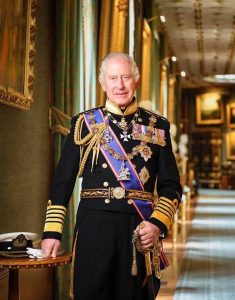
Following a review of the patronages held by the late Queen, conducted by the Royal Household, on 3 May 2024 Sir Clive Alderton, Principal Private Secretary to the King and Queen wrote to the club: ‘following the thorough analysis of over one thousand organisations, I am pleased to confirm that His Majesty would be delighted to accept the Patronage of the Civil Service Club. It is my great pleasure to share this news with you, to mark the first anniversary of Their Majesties’ coronation.’ On 16 May 2024 Club Chair Peter Wardle wrote to Sir Clive at Buckingham Palace, to thank him for his letter and to: ‘express what a great honour it is that His Majesty has accepted the Patronage of the Club.’ On 17 May the Club Chair wrote to Dr Simon Case, Cabinet Secretary and Head of the Home Civil Service; Sir Phillip Barton, Head of His Majesty’s Diplomatic Service; and Ms Cat Little, Civil Service Chief Operating Officer, to advise them of the patronage.
So much for the Civil Service Club, a fairly recent addition to the story of Whitehall. However, the plot of land on which it stands offers an equally fascinating tale and is of considerable historical interest. It encompasses such diverse issues as the private life of King Henry VIII, the Palace of Whitehall, the Office of the King’s Works, architect Inigo Jones, the Metropolitan Police, the London Fire Brigade and the Festival of Britain.
Part Two: The Story of Great Scotland Yard
The Priory and Hospital of St Mary Rounceval
Remarkable though it may seem to the reader, our story begins on 15 August 778 AD in a high mountain pass in the Pyrenees, near the border between France and Spain. That place being the traditional site of the Battle of Roncesvalles, in which the Basques ambushed and slaughtered the rearguard of the Frankish army, as it made its way across the mountains to Aquitaine in France. Charlemagne, King of the Lombards, was then campaigning in Spain. He had ravaged several towns south of the Pyrenees and razed the city of Pamplona. The Frankish army was led by Seneschal Eggihard and the rearguard by Roland, Prefect of the March of Brittany. The events of that day form the basis of the legend of the hero Roland, immortalised in the poem La Chanson de Roland, which would assume mythical dimensions in both medieval and renaissance literature.
In 1130 Sancho de la Rosa, Bishop of Pamplona founded an Augustinian abbey at Roncesvalles for the use of pilgrims, especially those on their way to Santiago de Compostela. The monks came to England in 1199 and, in 1231, William Marshall, 2nd Earl of Pembroke founded the Priory and Hospital of St Mary Rounceval at the village of Charing in Middlesex, ostensibly to aid pilgrims making their way to the shrine of St Edward the Confessor at Westminster Abbey. It was a daughter house of the monastery at Roncesvalles. That community originally consisted of a prior and brethren, who were subject to the rule of the mother house. Like all medieval hospitals, it was overtly religious in nature, being run by monks and drawing its inspiration from the corporal and spiritual works of mercy of Christianity. However, a 13th century hospital bears little comparison to any modern institution bearing that title today. The best that any soul who was taken seriously ill could expect was a bed, food and comfort in their ‘hour of need’.
Medical expertise was almost non-existent, other than a knowledge of herbs and their curative properties. From the description in deeds and plans, we can calculate that the priory and hospital occupied all of the land south of Charing, bounded by modern-day Whitehall, Great Scotland Yard and Northumberland Avenue. It distributed indulgences in the name of the Bishop of Pamplona and was notorious for abuses, even before the scandal of 1382 in which, the brethren were discovered to have forged a bull of excessive indulgence. In that age, indulgences were sold by church officials for the forgiveness of sins. With a nod and a wink to his readers, in his collection of stories The Canterbury Tales (1400), Geoffrey Chaucer would write: ‘With hym ther rood a gentil Pardoner, Of Rouncivale, his freend and his compeer, That streight was comen fro the court of Rome.’
Chaucer’s pardoner openly admitted corruption, whilst unashamedly hawking his wares. Such abuses were an affront to devout Christians and, in time, would lead to a German former monk named Martin Luther nailing his 95 theses to the door of All Saints’ Church in Wittenberg on 31 October 1517, thereby triggering the Protestant Reformation.
In the reign of King Henry V, Rounceval was suppressed for belonging to an alien monastery, along with all the other houses of that kind in the kingdom. It was restored by King Edward IV, only to be disbanded in King Henry VIII’s Dissolution of the Monasteries. He also seized their almshouse. The chapel and its appurtenances were granted in 1605 by King Edward VI to Sir Thomas Cawarden, Master of the Revels and Tents. The chapel was demolished in 1608. Most of the hospital was removed and the land became largely the site on which Henry Howard built Northampton House in 1608-09. Some of the monastic quarters remained as private residences, until they were demolished in 1705.
Yorke Place
The Palace of Westminster dates from the early eleventh century, when King Canute built his royal residence on the north bank of the River Thames. Successive kings added to the complex. At the close of his reign, King Edward the Confessor built Westminster Abbey on Thorney Island. He breathed his last on the stormy night of 4-5 January 1066, bequeathing the English a succession crisis, which would result in the Norman Conquest.
A man of boundless energy, William the Conqueror commenced building a new palace. His short-lived son King William II continued the process, which included Westminster Hall, commenced in 1097. King Henry III set in hand the construction of new buildings for the Exchequer and the Court of Common Pleas, along with the Court of the King’s Bench and the Court of Chancery. By 1245 the king’s throne was situated in the palace, thus signifying that it was literally the seat of royal power. The old Palace of Westminster was destroyed by fire in 1512, although it retained (and still does) its status as a royal palace. Over the centuries, what was left of the palace gradually gained an accretion of new buildings, until the fire of 1834, which destroyed all of it, excepting Westminster Hall. That building, with its magnificent hammer-beam roof, the largest medieval timber roof in Northern Europe dating from 1399 is now incorporated into the replacement palace, which today serves as the United Kingdom’s Houses of Parliament.
History tells us that there was a palace standing on the site of modern-day Whitehall as early as the Plantagenet era, when Hubert de Burgh, Earl of Kent, purchased land from the monks of Westminster Abbey and resided there. He was Chief Justiciar of England and Ireland, being one of the most powerful men in the kingdom during the reigns of the luckless King John and that of his infant son and successor, King Henry III.
According to the chronicler Matthew Paris, upon his death in 1243, de Burgh was buried in the Church of the Friars Preachers (commonly called the ‘Black Friars’) in Holborn and he left ‘Yorke Place’, as it was then known, to the friars. They sold it to the prelate and statesman Walter de Grey, who transferred it to the See of York as that diocese’s London residence. That archbishopric owned it for nearly three centuries.
In 1514 Thomas Wolsey was translated from the bishopric of Lincoln to the archbishopric of York. In 1515, he was created cardinal by Pope Leo X. The accounts for 1514-16 ’ concernyng bildyngs at Yorke Place’ show that ‘reparacions and workemanshypp … in my lord of Yorkes Place’ were being extensively carried out during those years. Among other buildings mentioned are: the hall, the chapel, ‘the grete gate towards the strete,’ ‘the grete bakery gate into the Gardyn,’ ‘a breke wall from the brode gate ayenst the Grene unto the grete gatehouse of my lords place,’ the chapel garden, the counting-house, the bake-house, the kitchen, the buttery, the wine-cellar, the fish-house, the scullery and the wardrobe. Despite him being the son of an Ipswich butcher, Wolsey’s appetite for the finer things in life ensured Yorke Place’s transformation into one of the most sumptuous residences in England, rivalled only by the Archbishop of Canterbury’s Lambeth Palace. Unlike his Lord and Saviour, Cardinal Wolsey dined off the finest gold plate and King Henry VIII was well-acquainted with Yorke Place’s galleries: ‘hanged with cloths of gold and tissue of divers makings and cloths of silver likewise on both sides and rich cloths of baudkin of divers colours.’ Notwithstanding that he was Lord Chancellor of England, one marvels at the unwisdom of the servant outshining his royal master and wonders whether he ever pondered the possible consequences of his actions.
The Palace of Whitehall
Cardinal Wolsey’s inability to persuade Pope Clement VII to grant Henry an annulment of his marriage to Queen Catherine of Aragon spelled his certain doom. On 19 October 1529 he was deprived of the Great Seal and informed that the king wished him to retire to Esher in Surrey. On 22 October he executed a deed acknowledging that he had incurred a praemunire (a 1353 statute which forbade, on pain of outlawry, confiscation of goods and imprisonment at the king’s pleasure, all appeals to authorities outside England in cases cognizable before the royal courts). He asked the king as part-recompense, to take into his hands all of his temporal possessions. He then retreated to his See to discharge those duties he had neglected during his years in government, but was soon recalled to answer charges of treason – a device often used by Henry against those who incurred his displeasure. Wolsey headed south for Westminster, but escaped the executioner’s block on Tower Hill, by expiring of natural causes at Leicester Abbey on 29 November 1529.
Henry had set his heart on obtaining Yorke Place, but there were difficulties, owing to the fact that it was not the cardinal’s private property, belonging as it did, to the See of York. However, as Henry’s friends, courtiers and enemies all learned, his patience was finite. Once his will was known, no man could gainsay him and expect to survive his wrath.
Although Henry had been born at the Palace of Placentia in Greenwich, as were his daughters Mary and Elizabeth, he was determined to transform Yorke Place into his principal London residence. He embarked upon the most ambitious building programme ever undertaken by an English monarch and spent prodigious sums realising his vision. By fair means or foul, he acquired all the land between Charing Cross and Westminster, incorporating the territory from the River Thames to St James’s Park and Green Park.
Henry hired the Flemish artist Anton van den Wyngaerde, who laid out extensive ornamental gardens, tennis courts, a tilt-yard for jousting, a bowling alley, a cock-pit, a mews, accommodation for the court and a barracks. By the time the works were complete, the new palace covered some 23 acres and Henry had supplanted the Abbot of Westminster as the neighbourhood’s principal landowner. The name ‘Whitehall’ or ‘White Hall’ is first recorded in 1532, having its origin in the Ashlar stone used for the buildings.
William Shakespeare’s 1613 play Henry VIII contains the line: ‘You must no more call it York Place – that is past: For since the Cardinal fell that title’s lost; ‘Tis now the King’s and called Whitehall.’ At that point, the thoroughfare we know today as Whitehall was called ‘Kinges Streate’ and it bisected the Palace of Whitehall, being a public right of way. The two halves of the palace were connected by a gatehouse, the Holbein Gate, which enabled Henry to traverse the palace unseen. He married Anne Boleyn at Whitehall in a secret ceremony on 25 January 1533 and Jane Seymour there on 30 May 1536. That complex monarch was called to meet his maker at Whitehall on 28 January 1547.
In the early 1600s visiting Moravian nobleman Baron Wildstein would describe the palace as: ‘A place that fills one with wonder … because of the magnificence of its bedchambers and living rooms, which are furnished with the most gorgeous splendour.’
The Union of the Crowns occurred with the accession of James VI, King of Scots, to the thrones of England and Ireland, which unified the realms of England, Scotland and Ireland for the first time under a single monarch on 24 March 1603. That event followed the death of Queen Elizabeth I – King Henry VIII’s second daughter, the ultimate monarch of the Tudor dynasty and James’s unmarried and childless first cousin, once removed.
The Village of Charing
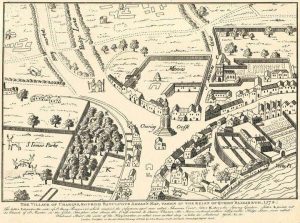
The Village of Charing by Radulphus Aggas during the reign of Queen Elizabeth I, 1578
On 28 November 1290 Eleanor of Castile, Queen Consort of King Edward I died at Harby in Lincolnshire. The funeral cortège made its way to Westminster Abbey with much ceremony and the king ordered stone crosses be erected to mark each place where her body had rested overnight on its final journey. In all, there were twelve: Lincoln, Grantham, Stamford, Geddington, Northampton, Stony Stratford, Woburn, Dunstable, St Albans, Waltham, Cheapside and the final halt was the village of Charing, which probably got its name from the Old English word cerring (meaning ‘bend’) referring to the meandering course of the nearby Thames. The Charing Cross was destroyed by order of parliament in 1647, in their quest to demolish monuments of superstition and idolatry.
Since 1675 that site has been occupied by Hubert Le Sueur’s equestrian bronze statue of King Charles I, which looks accusingly down Whitehall, to the site of his execution on 30 January 1649. In 1865 a replacement Charing Cross was erected on the forecourt of Charing Cross Railway Station. On Aggas’ map above, the letter I denotes the site of St Mary Rounceval. Letter K marks Spring Garden and Letter L indicates the Church of St Martin-in-the-Fields, dedicated to St Martin of Tours. Identifiable are the Royal Mews, Whitehall, St Martin’s Lane, the Haymarket and a kiln in Scotland Yard.
Scotland
The derivation of the name ‘Scotland’ for the northern component of the Whitehall neighbourhood may be found in the chronicler John Stow’s A Survay of London (1598) which tells us: ‘On the left hand from Charing Cross bee also divers fayre Tenements lately builded, till ye come to a large plotte of ground inclosed with bricke, and is called Scotland, where great buildings hath beene for receipt of the kings of Scotland, and other estates of that countrey; for Margaret Queene of Scots and sister to King Henry the eight, had her abiding there, when she came into England after the death of her husband, as the kings of Scotland had in former times, when they came to the Parliament of England.’
An earlier account is contained in Nicholas Bodrugan’s 1548 propaganda document, entitled An Epitome of the title that the Kynges Maiestie of Englande hath to the sovereigntie of Scotlande printed to promote young King Edward VI’s claim to the Scottish throne. The passage reads: ‘This Edgar enjoyned this Keneth there kyng ones in every yere, to repaire unto him into England for the makyng of lawes, which in those daies was by the noble men or piers accordyng to the order of Fraunce at this daie: to whiche ende this Edgar gave him a piece of grounde liyng beside the new palace of Westminster, upon whiche this Keneth builded a house, whiche by him and his posteritie was enioyed untill the reigne of Kyng Henry the seconde, in whose tyme upon rebellion by Willyam then kyng of Scottes, it was resumed into the kyng of Englandes handes; ye house is decayed, but the ground where it stode is called Scotland to this day.’
In 1296 King Edward I, ‘Hammer of the Scots’, invaded the Kingdom of Scotland to punish King John Balliol for his refusal to support English military action in France. Concurrently, he addressed a writ to the Sheriff of Middlesex, ordering him to seize any land or property in the county belonging either to the King of Scots or his subjects. The sheriff returned the writ endorsed with a note that: ‘Neither the King of Scots nor anyone ‘de regno Scocie’ held property in Middlesex, except Balliol, who held the vill of Tottenham.’ In 1436, in an inquisition taken before John Selby, Escheator of Middlesex, twelve jurors of Westminster stated that a piece of land, 14 perches in length along the street leading from Charing Cross to Westminster and six perches in width from the said street towards the Thames, had been given by a former king of England to a former king of Scotland, in order that the latter might build a house there in which to lodge when attending parliament but that, owing to the hostilities between the two kings, the land had not been built on. They added that a certain Richard Scarburgh received the profits of the ground, but were ignorant of his title to do so. The escheator’s account for that year stated that he had taken the ground into the king’s hand because of the outbreak of war with Scotland. In the following year custody of the ground was granted to one John Prud and it was described as a parcel of ground formerly belonging to the King of Scotland, lying between the ‘hospicium’ of the Archbishop of York on the south and the chapel of St Mary Rounceval on the north, the River Thames on the east and the street on the west.
In November 1519 King Henry VIII granted ‘Scotland’ to Cardinal Wolsey as: ‘a parcel of land which formerly belonged to the King of Scotland, in the County of Middlesex, with all appurtenances thereto belonging, as it lies between the inn of the Lord Archbishop of York on the south and the chapel of the Blessed Mary of Runcevall on the north and the water of Thames on the east and the royal way which leads from Charyngecrosse to Westminster on the west, now being in our hands.’
Scotland Yard
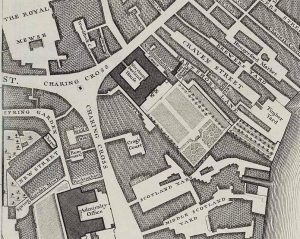
Northumberland House on John Rocque’s 1746 map of London.
During the course of his programme of works which expanded Yorke Place, Cardinal Wolsey left the area then known as ‘Scotland’ largely untouched. During the construction of King Henry VIII’s new palace, that neighbourhood increasingly came to be used by the Office of the King’s Works to house its burgeoning multitude of workshops and stores. Its wharf was ideal for unloading the substantial quantities of stone, timber and materials required for the extensive building works. It also contained a guard house and a granary.
Whilst the standards of cartography in the 18th and 19th century come nowhere close to the pin-point accuracy of our modern-day Ordinance Survey, what can be ascertained with a fair degree of certainty from both John Rocque’s 1746 map of London and Messrs Chawner and Rhodes’ meticulously hand-drawn 1829 map of Great Scotland Yard in the National Archives at Kew, is that the bottom left-hand corner of the gardens of Northumberland House are the location of the Civil Service Club at 13-15 Great Scotland Yard. In 1931 that portion of the roadway titled ‘Charing Cross’, which ran from Trafalgar Square down into the Whitehall thoroughfare was incorporated into Whitehall.
The Office of the King’s Works
The Office of the King’s Works was established in 1378 to oversee the building and repair of the royal castles and residences. In 1832 it became the Works Department within the Office of Woods, Forests, Land Revenues, Works and Buildings. It was reconstituted as a government department in 1851 and became part of the Ministry of Works in 1940. The latter organisation would play an important role in the story of the Civil Service Club.
By the start of the 17th century, Scotland housed the Office of the King’s Works and began to be described in accounts and documents as ‘Scotland Yard’. In 1615 Inigo Jones succeeded Simon Basil as the King’s Surveyor of Works, which placed him in charge of royal architectural projects the length and breadth of the realm. Neither Basil nor his predecessors had been men of exceptional attainments, the Royal Works in Queen Elizabeth I’s time being little more than a palace maintenance department.
As one of the first Englishmen to study architecture in Italy and a devoted student of the principles of Andrea Palladio, Jones transformed that organisation into something altogether more ambitious. In his capacity as Surveyor, he carried out the first proper survey of the standing stones at Stonehenge. In 1619 the Banqueting House in Whitehall was destroyed by fire and, between that year and 1622, Jones replaced it with the magnificent Palladian masterpiece regarded by some as his greatest achievement.
With the outbreak of the English Civil War in 1642, Jones was compelled to relinquish his office as Surveyor of Works and was with John Paulet, 5th Marquess of Winchester at the Third Siege of Basing House at Basingstoke, where, during the chaotic storming and sacking of that place, he was taken prisoner by Oliver Cromwell’s soldiers on 14 October 1645, clad only in a blanket. The marquess was discovered hiding in a bread oven. Much of Jones’ work would be destroyed in the Great Fire of London in 1666, but enough survives to demonstrate his genius. The poet John Milton is known to have had his lodgings in Scotland Yard, whilst serving as Latin Secretary to Oliver Cromwell. By that stage the sprawling Whitehall Palace was a hotch-potch of buildings in various architectural styles, with no unifying theme. The French physician and translator Samuel Sorbiére visited England in 1665 and described it thus:
‘Ill Built, and nothing but a heap of Houses, erected at divers times, and of different Models, which they made Contiguous in the best Manner they could for the Residence of the Court; Which yet makes it a more Commodious Habitation than the Louvre, for it contains above Two Thousand Rooms, and that between a Fine Park and a Noble River so that ’tis admirably well Situated for the Conveniency of walking and going about Business into the City.’ At the end of the 17th century Sorbiére’s countryman, Louis de Rouvroy, duc de Saint-Simon put it rather more succinctly, describing Whitehall as: ‘The largest and ugliest palace in Europe.’
On the afternoon of 4 January 1698, a Flemish laundry-maid was drying wet linen sheets on a charcoal brazier in one of the bedchambers of Whitehall Palace. It was forbidden to leave braziers unattended. However, for reasons unknown, the maid left the room. In her absence, it took only moments for the sheets to ignite and set fire to the bed hangings. In the days following, the entire, rambling Palace of Whitehall burned to the ground. An anguished King William III implored Surveyor of Works Sir Christopher Wren to save the Banqueting House. Wren instructed his bricklayers to block-up the main window on the building’s south side to prevent the flames from entering. Some 20 buildings were destroyed or pulled down to create a firebreak and the building was saved.
Northumberland House
Henry Howard, the second son of Henry, Earl of Surrey was in disfavour throughout Queen Elizabeth’s reign, on account of his association with Mary Queen of Scots and his Catholic sympathies. He succeeded however, in ingratiating himself with her successor, King James VI of Scotland, upon whose accession to the English throne, he was sworn of the Privy Council. He was created Earl of Northampton in 1604 and gained notoriety on account of his suspected complicity in the 1613 murder of Sir Thomas Overbury in the Tower of London, but nothing was ever proved against him. In the period 1608-09 he built a large Jacobean townhouse facing onto Charing Cross, which included extensive gardens and adjoined Scotland Yard to the west. That site was the eastern portion of the former property of the chapel and hospital of St Mary Rounceval. The house, which was of brick, with stone dressings, was initially designated ‘Northampton House.’ The façade of the building in the Strand was some 162 feet wide, the depth of the house being marginally greater. It had a single central courtyard and turrets in each corner. The layout reflected medieval tradition, with a great hall and separate apartments for members of the household. Many of the apartments were reached from external doors in the courtyard in a manner still seen at certain Oxford colleges. The exterior was embellished with classical ornament. The most striking external feature was the elaborate four-storey carved stone gateway fronting the Strand. The garden was 160 feet wide and more than 300 feet long, but, unlike its neighbours to the east, did not extend all the way down to the River Thames.
Upon Northampton’s death in 1614 the property passed to his nephew, Thomas Howard, 1st Earl of Suffolk, who had commanded the GOLDEN LION at the defeat of the Spanish Armada in the action-packed summer of 1588. That property would then become known as ‘Suffolk House’. Howard was appointed Lord High Treasurer in 1614, but was suspended from office in 1618 for embezzling funds. However, he retained the king ’s favour and the greater part of the fine imposed upon him was remitted. He died at Suffolk House in May 1626. Ownership of the house passed successively to his son Theophilus, 2nd Earl of Suffolk, who died there in June 1640 and his grandson James, the 3rd Earl.
In 1642 Lady Elizabeth Howard, second daughter of Theophilus, married Algernon Percy, 10th Earl of Northumberland and, by her marriage settlement, Suffolk House was transferred to the bridegroom upon payment of £15,000 to his wife’s family. It then became known as ‘Northumberland House.’ It suffered damage in the John Wilkes-inspired riots of May 1768, when Hugh Percy, 1st Duke of Northumberland saved his property by the quick-thinking expedient of opening Ye Old Ship Tavern (today’s Trafalgar Theatre at 14 Whitehall), thus distracting the thirsty mob. In the mid-19th century, the grand mansions on the Strand disappeared one by one, as the area became increasingly commercial, thus rendering it unfashionable to the aristocracy. George Percy, 5th Duke of Northumberland was reluctant to quit his London home, but came under pressure from the Metropolitan Board of Works, which wished to build a new thoroughfare through the site. After a fire, which caused much damage, in 1866, he accepted an offer of £500,000.
Northumberland House was demolished and Northumberland Avenue constructed in its place, thus connecting Trafalgar Square with Victoria Embankment. Designed by Sir Joseph Bazalgette, Chief Engineer of the Metropolitan Board of Works, the cut-and-cover tunnel for the Metropolitan District Railway would be built within the Victoria Embankment and roofed over, to take the new roadway along the River Thames.
The Evolution of Scotland Yard
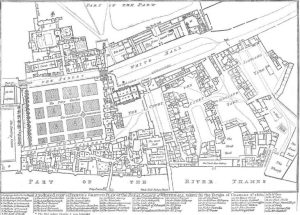
John Fisher ’s 1680 plan of the Palace of Whitehall.
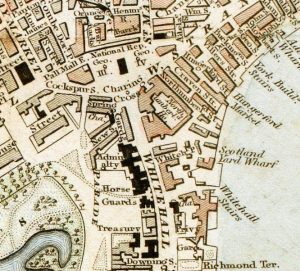
Detail of The Improved Map of London engraved by William Schmollinger, 1833.
Great Scotland Yard
Richard Horwood’s 1799 map of London depicts Great Scotland Yard on the east side of Whitehall, opposite Thomas Ripley’s Admiralty, completed in 1726. Below it, are two streets that were culs-de-sac: Middle Scotland Yard, where Whitehall Place is today, and Lower Scotland Yard, entered from Middle Scotland Yard. Lower Scotland Yard was where architect Clyde Young’s War Office building would be erected in 1906, but was, according to the 1862 map of the area, renamed Middle Scotland Yard when Whitehall Place, originally a cul-de-sac, took the place of the original Middle Scotland Yard.
The post of Commissioner of Police for the Metropolis was created by the Metropolitan Police Act 1829 and until 1855, was held jointly by two individuals, initially Lieutenant-Colonel Charles Rowan and the barrister Richard Mayne (appointed without interview). Their office at 4 Whitehall Place had its rear entrance, used by the public, on Great Scotland Yard. That circumstance would forever link the name of the locality with the story of the Metropolitan Police, serving as its headquarters for some 60 years.
On 30 May 1884 Fenians exploded a device, which blew a hole in the wall of Scotland Yard and damaged the Rising Sun Public House opposite. Its enterprising landlord charged sightseers thruppence a head to inspect the damage. In 1892 the police relocated to the turreted premises on the Victoria Embankment designed by architect Richard Norman Shaw which would in time, become known as ‘New Scotland Yard’.
In 1967, needing a larger headquarters, a further move took place to Broadway, St James’s Park, which would also become ‘New Scotland Yard’. There, the headquarters remained for just under half a century, before returning in 2016 to the Thames waterfront, in the form of the redesigned Curtis Green Building on Victoria Embankment, situated between the Norman Shaw Buildings and the Ministry of Defence. Today, Norman Shaw North and Norman Shaw South are part of the parliamentary estate, housing the offices of members of parliament. Originally constructed for the Earl of Lonsdale and subsequently acquired by the First Lord of the Admiralty, the Metropolitan Police’s Mounted Branch Stables are at 7-11 Great Scotland Yard, next-door to the club.
In 1862 civil engineer Sir Joseph Bazalgette commenced work on the construction of his Victoria Embankment to regularise the passage of the River Thames. It was but one element of a three-part project, the others being the Albert Embankment, from the Lambeth end of Westminster Bridge to Vauxhall; and Chelsea Embankment, extending from Millbank to the Cadogan Pier at Chelsea. The Victoria Embankment phase was completed in July 1870. It reclaimed 22 acres of land from the winding river and from that point, the Thames would no longer lap at the eastern end of Scotland Yard.
Scotland Dock would be filled in and its wharf dismantled. Bazalgette not only embanked the river, but also built three bridges (Hammersmith, Putney and Battersea) across it. By the late 19th century, the layout of the neighbourhood started to resemble what we recognise today. Standing on the corner of Great Scotland Yard and Whitehall, the Clarence Public House, named after King William IV, who had been Duke of Clarence, dates from 1862. At the time of its construction, the design incorporated an arch across the roadway of Great Scotland Yard and it was not there for ornamental reasons, given that it supported two storeys of the pub and abutted the building next to it in Whitehall. However, it quickly became apparent that the archway was far too narrow for the volume of traffic trying to access it. That awkward architectural feature would be removed in 1908.
Great Scotland Yard Fire House
The Royal Society for the Protection of Life from Fire was established in 1836. It helped people escape from burning buildings by providing escape ladders, which were kept in city churchyards during the day and placed on street corners of the metropolis at dusk.
On 1 January 1833 ten independent fire insurance companies formed the London Fire Engine Establishment, which sought to provide the public with an effective fire service. James Braidwood of Edinburgh was appointed superintendent and he introduced a uniform which, for the first time, included personal protection from firefighting hazards.
With 80 firefighters and 13 fire stations, it was a private enterprise funded by the insurance companies, but was primarily responsible for saving material goods from fire. Several large fires, most notably at the Palace of Westminster on 16 October 1834 and the Great Tooley Street Fire of 22 June 1861 (in which, Braidwood was killed), spurred the insurance companies to lobby the government to provide a fire brigade at public expense. After due consideration, in 1865 the Metropolitan Fire Brigade Act was passed. It ordered that the Metropolitan Fire Brigade be brought into being as a public service on 1 January 1866 and charged it with the ‘Protection of Life and Property from Fire within the Metropolis.’ Its first leader was Superintendent Eyre Massey Shaw, a former head of police and fire services in Belfast. On 15 August 1904 that organisation was re-named the London Fire Brigade by Section 46 of the London County Council (General Powers) Act. In Norman Seymour’s The Story of 13-15 Great Scotland Yard he related: ‘On 7 October 1880, the Chief Fire Officer reported that the existing fire house in Chandos Street was no longer adequate for its task and that it could not be adapted suitably.’
The Metropolitan Board of Works searched for a new site and on 14 February 1881 approved the building of a new fire house on a plot of land, in the corner of the one-time garden of Northumberland House, bounded on the Whitehall side by the Rising Sun Public House at 11 (demolished 1910) and on the Northumberland Avenue side by the Society for Promoting Christian Knowledge (today, the Nigeria High Commission).
The fire house opened in 1884 and, in large part, its layout dictated the design of today’s Civil Service Club. It was designed to accommodate a married officer, 15 married men, six single men, one coachman, three engines, three escapes, one hose cart and two pairs of horses. The ground floor comprised the engine room, watch room, stables and ancillary areas. An entrance for escapes was located at the east side of the building.
The original basement contained both coal and wood stores. The upper floors contained the mess, along with the single and mixed living accommodation. The building was constructed of load-bearing brickwork, comprising grey stocks laid in English bond, with red Fareham facings on the front elevation, relieved with red Mansfield stone and blue Staffordshire bricks. The building is set back 26 feet from the roadway, due to a last-minute objection from Messrs Cluttons, a firm of solicitors, which then occupied offices on the opposite side of the street. They claimed ‘ancient lights.’ Therefore, the yard that should have occupied the rear of the building appeared at the front
instead. The fireman’s watch-tower on the far left-hand side of the building can be observed by standing in the street, under the archway of Scotland Place, opposite the premises. It survives at the insistence of Westminster City Council. The introduction of the telegraph would render the tower redundant and in time, the internal combustion engine would do the same for the horses. In 1921 the firemen were re-located to 72 Shaftesbury Avenue in Soho.
The Fireman’s Watch-Tower
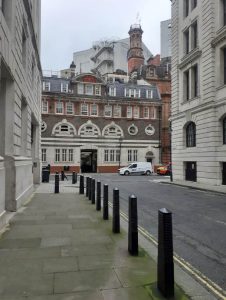

The fireman’s watch-tower at 13-15 Great Scotland Yard, behind the Metropolitan Police’s Mounted Branch Stables, viewed from under the archway in nearby Scotland Place.
The Festival of Britain
The Ministry of Works then allocated the fire house to the Ministry of Pensions. That department was created in 1916 to handle the payment of war pensions. By the end of 1920, it had 19,121 staff and was paying 1,600,000 pensions. In 1939 it was expanded by the secondment of civil servants from the Inland Revenue and other departments. In 1940 most of the ministry was relocated to Thornton-Cleveleys in Lancashire. During the Second World War the building is believed to have functioned as an intelligence centre.
The notion for holding an exhibition in 1951 came from the Royal Society of Arts in 1943, believing that an international event should be held to mark the centenary of the 1851 Great Exhibition. In 1945 the government appointed a committee under Lord Ramsden to consider how exhibitions could promote exports. When it reported back, the idea of an international exhibition had been dropped on the grounds of cost and instead a series of displays about the arts, architecture, science, technology and industrial design was suggested. Clement Attlee’s government seized the notion as an opportunity to give the nation a boost after the war and a chance to celebrate ‘the arts of peace’. It was intended to demonstrate Britain’s contribution to civilisation, past, present and future in the arts, science, technology and industrial design. The main exhibition site was on London’s South Bank. That small 27-acre site had previously accommodated warehouses and a brewery damaged in the Blitz. Hugh Casson was appointed Director of Architecture for the Festival and he brought in dozens of young architects to design the site’s buildings and landscaping. On 3 May 1951 King George VI opened the Royal Festival Hall on London’s South Bank. Gerald Barry, the Festival Director summed up the hopes of the organisers by describing it as a: ‘tonic to the nation.’ Although the main venue was in London, it was a nationwide affair, with exhibitions in many towns and cities throughout Britain. Events included the London South Bank Exhibition with its futuristic-looking Dome of Discovery, which was then the largest aluminium structure ever to have been erected.
Another iconic structure, and the most remembered, was the Skylon. That steel and aluminium structure lacked a practical function save as a landmark and was described as ‘…a huge, lively joke, a tribute only to the spirit of nonsense and creative laughter’. Other sites included the Pleasure Gardens in Battersea Park and a ‘Live Architecture’ exhibit in Poplar, East London set out as a model for Britain’s New Towns. An Exhibition of Farm and Factory was held in Belfast. Glasgow was the site of an Exhibition of Heavy Industry and two travelling exhibitions carried the festival further afield, one aboard the decommissioned aircraft carrier HMS CAMPANIA, the other on a fleet of lorries. Hundreds of events were held up and down the country. The festival turned a profit and was the catalyst for a new design aesthetic, launching the career of a number of textile, furniture and graphic designers. By the time the festival closed in September 1951, more than one in three Britons had attended, over eight million at the South Bank alone. Today, the only remaining element is the Royal Festival Hall, which is now a Grade I listed building, the first post-war building to become so protected. Designed by Sir Robert Matthew, Leslie Martin and Sir Hubert Bennett, it was built specifically for the project.
The Festival of Britain was formally established by HM Treasury in March 1948 and existed as a separate government department from April 1949 to March 1953. At that time 13-15 Great Scotland Yard housed a press bureau, run by Bernhard ‘Bert’ Garai’s Keystone Press Agency, which handled much of the festival’s public relations.
The Civil Service Club in 2019
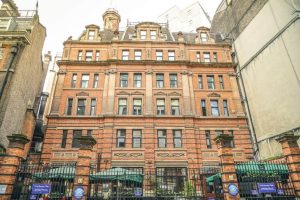
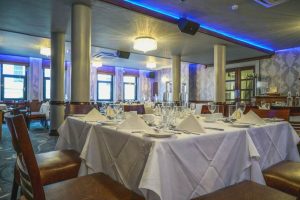
Annexes
ANNEX A
CIVIL SERVICE CLUB TO BE OPENED WITH THE
AID OF THE QUEEN’S WEDDING PRESENT FUND
Members of the Civil Service and Foreign Service who contributed to the Wedding Present for Her Majesty The Queen in 1947 will remember that two silver salvers were, as a token of their great regard, presented to Her Majesty. The remainder of the sum subscribed was, by her wish, to be applied to some object of general benefit to the Civil and Foreign Services.
Much time and thought has been given to devising a scheme from which industrial and non-industrial grades alike could benefit. I am now able to report that a suitable project has been evolved which has Her Majesty’s warm approval. It has also been welcomed by representatives of the staff – industrial and non-industrial – who have been consulted throughout.
A Civil Service Club situated in the heart of London has long been an objective of the Civil Service Sports Council but has been unattainable for lack of funds to meet the capital expenditure involved. Her Majesty has most graciously agreed that the Fund which was subscribed for her Wedding Present should be used to enable the Council to realise this ambition. It is therefore to be handed over to the Sports Council to meet the capital expenditure required to adapt, equip and redecorate the excellent premises which the Sports Council have found, after much search. Members’ subscriptions and the proceeds of charges for club services will provide the necessary annual revenue. The club premises are in Great Scotland Yard (two minutes from Trafalgar Square and Charing Cross). They could not be better placed for London civil servants as a whole, nor for their colleagues outside London, who we hope will be glad to take advantage of the amenities of the club when visiting London.
The premises will be taken over on 1 February next. For the time being the club will have the use of the three lower floors only, but it is intended to provide as soon as possible a small number of bedrooms for visiting members. In the meantime, in addition to providing a first class venue for the membership, amenities will include a full restaurant service, lounges and rooms for reading, writing, cards, television and so on.
Membership is to be open to all civil servants, industrial and non-industrial, and with a view to attracting every grade the annual subscription has been fixed at 10s. for London members and 5s. for country members.
This is an enterprise which deserves full support. The fact that Her Majesty has so generously allowed her Wedding Gift to be associated with it will, I am sure, bring a universal welcome to the club throughout the Civil and Foreign Services. Forms of application for membership will be available shortly.
EDWARD BRIDGES
11th December 1952
ANNEX B
THE EDWARD BRIDGES ROOM
Edward Ettingdene Bridges was born on 4 August 1892 at Yattendon Manor in Berkshire. He was the third of the three children and only son of Robert Seymour Bridges (later Poet Laureate) and Mary Monica Waterhouse. Edward arrived at Eton College in 1906, where he received a grounding in the Classics. He won a history demyship to Magdalen College, Oxford and went up in 1911. There he commenced reading Greats, with the intention of taking his degree in two-and-a-half years, then going on to read Modern History.
Bridges was awarded a First in Greats in July 1914, but that September, as an officer cadet, he was called up to serve with Oxfordshire and Buckinghamshire Light Infantry on the Western Front in France. On 2 March 1917, whilst serving as adjutant of the 4th battalion in the front line, opposite La Maisonette, Herbecourt, he was injured by a bullet, which shattered his right arm. He was declared unfit for further service and obtained a post as a temporary administrative assistant with HM Treasury in Whitehall.
He demonstrated such promise in the role, that Sir Malcolm Ramsay, Treasury Controller of Establishments wrote to the Civil Service Commissioners, recommending his assignment to the Treasury as an assistant principal. In 1919-20 he took the All Souls Prize Fellowship Examination, which led to the award of an All Souls Fellowship. In June 1922 Bridges married Katharine (Kitty) Dianthe Farrer, daughter of Thomas Cecil Farrer, 2nd Baron Farrer. Their union would be blessed with two sons and two daughters.
In the years 1927-34, Bridges was Deputy Establishment Officer of HM Treasury and served as secretary to a number of committees, including three Royal Commissions. From 1926 he was Official Side Secretary to the National Whitley Council. He was promoted principal assistant secretary in January 1937 and, when Sir Maurice Hankey retired in 1938, Sir Warren Fisher, then Head of the Home Civil Service, recommended him as Secretary to the Cabinet. In that role, Bridges served Prime Ministers Neville Chamberlain and Winston Churchill during the darkest days of the Second World War.
Sir Edward was responsible for recording the decisions of the War Cabinet and its committees and ensuring that the outcome of their deliberations were put into effect. Churchill asked him for advice on how a central statistical office could be created within the prime minister’s office, in order to consolidate and issue authoritative working statistics. Sir Edward’s work on the subject led to the creation of the Central Statistical Office in 1941, for the purpose of handling the statistics required for the war effort and developing national income accounts. In 1946 Bridges was appointed Permanent Secretary to HM Treasury and Head of the Home Civil Service, a position he held until 1956. In 1950, he delivered a lecture, which provided an overview of the stages through which the Home Civil Service had evolved since the publication of Stafford Northcote’s and Charles Trevelyan’s seminal report of 1854 and would later be published as Portrait of a Profession: The Civil Service Tradition. In 1939, Bridges was appointed Knight Commander of the Order of the Bath. In 1953 he was sworn of the Privy Council and, in 1957, was raised to the peerage as Baron Bridges of Headley, in the County of Surrey and of Saint Nicholas at Wade, in the County of Kent. In 1965 he was invested a Knight of the Garter. In retirement Lord Bridges served as Chancellor of the University of Reading. He was granted honorary degrees from several universities and appointed FRS. Lord Bridges died at Winterfold Heath, Surrey on 27 August 1969 at the age of 77.
ANNEX C
THE MILNER-BARRY ROOM
Philip Stuart Milner-Barry was born on 20 September 1906 at Hendon. He was the second youngest of the five sons and daughter of teacher Edward Leopold Milner-Barry and his wife, Edith Mary Besant. Philip was educated at Cheltenham College and Trinity College, Cambridge. At the start of the Great Depression, he commenced work as a stockbroker, an occupation wholly unsuited to his talents. He survived that experience through his devotion to chess. One of the most gifted attacking players of his generation, he won the British Boys’ Championship in 1923 and played for England in the International Chess Olympiads of 1937, 1939, 1952, and 1956. He was chess correspondent for The Times 1938-45. He was playing chess for England in Argentina when war broke out in 1939.
Gordon Welchman, who had been at Trinity with Milner-Barry, recruited him to the Government Code and Cypher School (GCCS) at Bletchley Park. He joined Hut 6, which analysed Wehrmacht and Luftwaffe Enigma signal traffic. Despite his first-class brain, Milner-Barry always maintained that he was not clever enough to be a cryptanalyst.
Initially his team searched for ‘cribs’ (plain text of messages enciphered on Enigma), without which, it was almost impossible to break Enigma keys quickly. Bypassing Bletchley Park’s leadership, Milner-Barry was joint-author with Hugh Alexander, Alan Turing and Welchman of a memorandum to Prime Minister Winston Churchill in October 1941, which explained that the lack of a number of junior staff (probably about a hundred) was impeding the work of Huts 6 and 8 (Kriegsmarine Enigma). Stewart Menzies, the head of MI6, who had overall responsibility for GCCS, had failed to ensure it was adequately staffed. Judging himself the most expendable member of the team, Milner-Barry took the memo to the prime minister. An avid consumer of their product, Churchill swung into ‘Action This Day’ mode and thundered to his aide, General ‘Pug’ Ismay: ‘Make sure they have all they want on extreme priority and report to me that this has been done.’ As Hut 6 expanded, Milner-Barry became deputy head and then head of the cryptanalytical operational watch. After the BRUSA (Britain-USA) agreement of May 1943 on dividing signals intelligence work against Germany, Italy and Japan, the Americans began to arrive in numbers and made an effective contribution to the work of the team. By September 1943, when Milner-Barry became head of Hut 6, it comprised 450 staff. He always felt that his team’s grip on Enigma was precarious, but it would be sustained until the end of the war. He later wrote: ‘For both Hugh and myself it was rather like playing a tournament game (sometimes several games) every day for five and a half years.’ After the war, Milner-Barry joined HM Treasury as a principal. He married Thelma Tennant Wells in 1947. Under the rules of the day, she had to resign from the Treasury.
They had a son and two daughters. Milner-Barry rose to the grade of under-secretary and reached retirement age at 60 in 1966. That year he was appointed Civil Service Department Ceremonial Officer, responsible for the honours system. He retired in 1977. The fact that Britain had broken German codes on a massive scale during the Second World War remained a secret and it was only in the 1980s that books began to appear, revealing the role played by GCCS in securing victory. In October 1991, Milner-Barry returned to Downing Street with a petition signed by more than 10,000 people, asking for Bletchley Park to be preserved as a monument. He was appointed OBE for his wartime work in 1946, CB in 1962 and KCVO in 1975. He died on 25 March 1995.
ANNEX D
THE ELIZABETHAN ROOM
The Elizabethan Room is named after the reign (1558-1603) of England’s last Tudor monarch, Queen Elizabeth I. The daughter of King Henry VIII and his wife Anne Boleyn, she was England’ s ‘Gloriana’ – a virgin queen, who saw herself as wedded to her country. King Henry’s break with Rome in 1533 ushered in an era of religious division in the British Isles, although his daughter Queen Mary I ‘ Bloody Mary’ was Catholic and sought to re-impose Catholicism during her short reign (1553-58). Following her death, Queen Elizabeth I resumed Henry’s policy of rejecting papal authority, aiming to return England to the Protestant faith. As a result, England’s Catholics were persecuted, the Mass was banned and priests hunted down. Elizabeth herself did not care overmuch for matters of conscience, famously stating: ‘I would not open windows into men’s souls.’
During her reign, England experienced domestic peace and growing prosperity. That happy circumstance in turn, fostered the flowering of cultural growth on a scale never before seen in these islands. Elizabeth ’s reign would usher in poets like Edmund Spenser and men of science and letters like Francis Bacon. In 1576, the actor and impresario James Burbage built The Theatre at Shoreditch, the first permanent, dedicated theatre built in England since Roman times, and it was followed by many others. The theatre scene, which performed both for the court and nobility in private and the general public, became the most crowded in Europe. It would call forth such stellar talents as Christopher Marlowe, Thomas Kyd, Thomas Dekker, Ben Jonson and William Shakespeare.
Many of the writers, philosophers and artists of the day enjoyed the patronage of members of Elizabeth’s court and their works often referenced the queen. Those cultural achievements did not just happen to be created while she was on the throne – rather, her actions, image and the court atmosphere nurtured, influenced – even inspired – works of literature. Poetry, music, the fine arts and learning in general would all flourish. For that reason, the Elizabethan Age is considered by historians to be a ‘golden age’ and is so regarded, because of its contrast with the turmoil of the periods both before and after it.
It brought a welcome respite between the English Reformation, with its battles between Catholics and Protestants, and the bloody contest between parliament and King Charles I, that would wrack the entire British Isles barely 30 years after Elizabeth’s death.
Elizabeth made building England ’s naval strength a priority. She risked war with Spain by supporting the ‘Sea Dogs’ John Hawkins and Francis Drake, who preyed on the Spanish merchant ships carrying gold and silver from the New World. That led to the Anglo-Spanish War of 1585-1604. When Spain set about invading and conquering England in 1588, that enterprise was a fiasco. Superior English ships and seamanship foiled the invasion and led to the destruction of the Spanish Armada, marking the high point of Elizabeth’s reign. In her speech to the troops gathered at Tilbury Camp, she told them: ’I know I have the body of a weak, feeble woman; but I have the heart and stomach of a king, and of a king of England too.’ During her reign English explorers sought new trade routes, seeking to expand English trade into the Spanish colonies in the Americas. Sir Francis Drake, one of the commanders in the defeat of the Armada, was one of the founders of England’s naval tradition. His ship, the GOLDEN HIND was one of the first to circumnavigate the world. Sir Humphrey Gilbert taking possession of St John’s in Newfoundland on 5 August 1583 signalled the foundation of Britain’s overseas empire.
ANNEX E
THE TRAFALGAR ROOM
The Civil Service Club is located a mere five minutes away from Trafalgar Square, which commemorates Britain’s greatest naval victory. In 1805 the French Empire, under Napoleon Bonaparte, was the dominant military land power on the European continent, while Britain’s Royal Navy controlled the seas. Early in 1805 Vice-Admiral Lord Nelson commanded the British fleet blockading the port of Toulon. The French fleet commanded by Vice-Admiral Pierre-Charles Villeneuve evaded Nelson when the British were blown off station by bad weather. Nelson chased the French fleet to the Caribbean and back. At 0600 on 21 October 1805 the two fleets sighted each other off Cape Trafalgar, between Cadiz and the Strait of Gibraltar, and at 0640 Nelson gave the order ‘prepare for battle’. The British fleet of 27 ships was outnumbered, the Franco-Spanish fleet of 33 vessels totalled nearly 30,000 men and 2,632 guns, to Nelson’s 18,000 men and 2,148 guns.
Nelson devised an unorthodox battle plan which called for his ships to attack the enemy broadside in two parallel lines, break into the enemy’s formation and blast his opponents to smithereens, at close quarters. At 1150 Nelson in his flagship, HMS VICTORY, famously signalled the fleet: ‘England expects that every man will do his duty.’
Villeneuve hoisted the signal ‘engage the enemy’ and the French vessel FOUGUEUX fired the first shots at Vice-Admiral Cuthbert Collingwood’s ship ROYAL SOVEREIGN. Then Nelson’s squadron, with twelve ships, attacked the van and centre of Villeneuve’s line, which included Villeneuve in the BUCENTAURE. The majority of Nelson’s squadron broke through and shattered Villeneuve’s line in the melée. The battle progressed largely according to Nelson’s plan. Six of the leading French and Spanish ships, under Rear-Admiral Pierre Dumanoir le Pelley, were ignored in the first attack and at about 1530 were able to turn about to aid those behind. But Dumanoir’s ineffectual counter-attack was driven off. Collingwood, in the ROYAL SOVEREIGN, completed the destruction of the enemy rear and the battle ended at about 1700. Nelson was mortally wounded by a marksman in the tops of the French ship REDOUBTABLE and taken below to the ship’s cockpit. Captain Thomas Hardy reported to Nelson that the battle was won. ‘Thank God I have done my duty’ were his last words and he expired at 1630.
Villeneuve was captured and his fleet lost some 14,000 men, of whom, half were taken prisoners of war. His flagship BUCENTAURE was captured, along with many others. Of the 33 French and Spanish ships which departed Cadiz, only eleven would return to port. Many were wrecked in a storm as they tried to make safe harbour. Villeneuve returned to France, only to die mysteriously in the Hôtel de la Patrie in Rennes. The British, despite losing 449 sailors during the engagement, did not lose a single ship.
Commissioned for service in the American War of Independence, between 1778 and 1812, HMS VICTORY took part in five naval battles. Trafalgar was not only the most famous, but also her last. Today the oldest commissioned warship in the world may be seen at No 1 Dock in Portsmouth Historic Dockyard. At Nelson’s state funeral held on 9 January 1806, he was interred in the crypt of St Paul’s Cathedral. He was entombed in a black marble sarcophagus originally intended for Cardinal Thomas Wolsey. The Battle of Trafalgar established Britain as the world’s dominant naval power for the next century. It also confirmed Nelson’s reputation as one of the greatest naval strategists of all time. To this day, the Senior Service celebrates Trafalgar Day each year on its anniversary.
ANNEX F
THE CHURCHILL ROOM
Winston Churchill was born on 30 November 1874 at Blenheim Palace in Oxfordshire. His father was Lord Randolph Churchill and his mother Jennie Jerome was a New Yorker. Winston attended Harrow and then Sandhurst. In 1899 he resigned from the army and travelled to South Africa to report on the Boer War. He was captured and interned, but escaped, becoming a national hero. In 1900 he was elected Conservative MP for Oldham but, after policy disagreements, crossed the floor to join the Liberals in 1904. In 1906 he became Under-Secretary of State for the Colonies. In 1908 he became MP for Dundee and that year, was appointed President of the Board of Trade. He was responsible for the Trade Boards Act of 1909, which set minimum wages for workers in certain trades.
He also introduced Labour Exchanges. In 1910 Churchill became Home Secretary and, in 1911, First Lord of the Admiralty. In the Great War he was blamed for the failure of the Dardanelles Campaign. In July 1917 he became Minister of Munitions. The war ended in November 1918 and the Liberals won the snap election that December. In 1919 Churchill became Secretary of State for War. In 1921 he was appointed Secretary of State for the Colonies. In 1924 he became Chancellor of the Exchequer and, in 1925, returned the country to the gold standard, a decision he later realised was a serious mistake, as it meant the pound was overvalued. He rejoined the Conservatives in 1925. In 1929 the Tories lost their majority in the Commons and a minority Labour government took office.
In 1931 a national government, made up of all parties, was formed to deal with the economic crisis, but Churchill was left out in the cold. In the 1930s he argued strongly for rearmament. He opposed Prime Minister Neville Chamberlain’s appeasement policy and was proved right when Germany occupied Czechoslovakia in 1939. When the Second World War began, Churchill returned to the Admiralty. Chamberlain resigned in the aftermath of the Norway Campaign and Churchill became premier on 10 May 1940.
That same day, German forces invaded Belgium and The Netherlands. France surrendered on 21 May, but the Germans lost the Battle of Britain fought in the skies over England that summer. Nevertheless, the Germans had further successes. In April 1941 they conquered Yugoslavia and Greece. In May 1941 they captured Crete. The situation began to change in June 1941, when Hitler invaded Russia. Churchill always detested communism, but promised the Russians material assistance. On 7 December 1941 the Japanese attacked Pearl Harbor. In November 1942 the British won a decisive victory at El Alamein in Egypt and, in early 1943, the Russians won a victory at Stalingrad. The Allies invaded Sicily in July 1943, then Italy in September. Meanwhile, the Russians won another victory at Kursk in July 1943 and the tide turned against the Germans. The Allies invaded France in June 1944 and Germany surrendered in May 1945. In July 1945 Labour won a general election and Churchill became Leader of the Opposition. In March 1946 with the onset of the Cold War, he gave a speech at Fulton, Missouri in which he said: ‘From Stettin in the Baltic to Trieste in the Adriatic, an iron curtain has descended across the continent’. The Tories won the election in 1951 and Churchill became prime minister.
In recognition of his historical works, he was awarded the Nobel Prize for Literature in 1953. He remained in office until 1955, when he resigned. He remained an MP until the general election of 1964. He suffered a series of strokes and died on 24 January 1965, aged 90. His state funeral at St Paul ’s Cathedral palpably marked the end of an epoch.
ANNEX G
CHAIRS OF THE CIVIL SERVICE CLUB, GREAT SCOTLAND YARD
- Frederick Adolf Hartman 1953-1958
- Sir Frederick Aldridge 1958-1965
- Mr H Pitchforth 1965-1968
- Anthony Sutherland 1968-1973
- John Perrin 1973-1976
- Maurice Mendoza 1976-1981
- Don Bryars 1981-1985
- Alan Atherton 1985-1989
- John Pestell 1989-1990
- Barry Miller 1990-1995
- David Butler 1995-1997
- Don Brereton 1997-2005
- John Barker 2005-2007
- Chris Johnson 2007-2008
- John Whittaker 2008-2017
- Sir Peter Housden 2017-2023
- Peter Wardle 2023-
Mr F A Hartman MBE, Founder Chairman of the Civil Service Club 1953-1958